Bringing down silos in the healthcare industry
Cook Medical leads it’s first-ever reimbursement workshop in Germany focused on endovascular treatment of aortic aneurysms with Cook devices.
A bridge
On February 2, around 120 people attended a WebEx-based workshop dedicated to the reimbursement for endovascular treatment of aortic aneurysms. Around 100 of them were medical controllers, procurement operators, medical coders, and physicians from across all of Germany.
This workshop was a first for Cook Medical.
Verena Schirmer (former Reimbursement Program Manager–Germany, Austria, Switzerland), who spent 14 months with Cook as a contract employee, shared reimbursement knowledge and best practices on how to correctly code the implantation of Cook aortic technologies, while Alexander Honings (Corporate Account Executive) led the meeting as moderator.
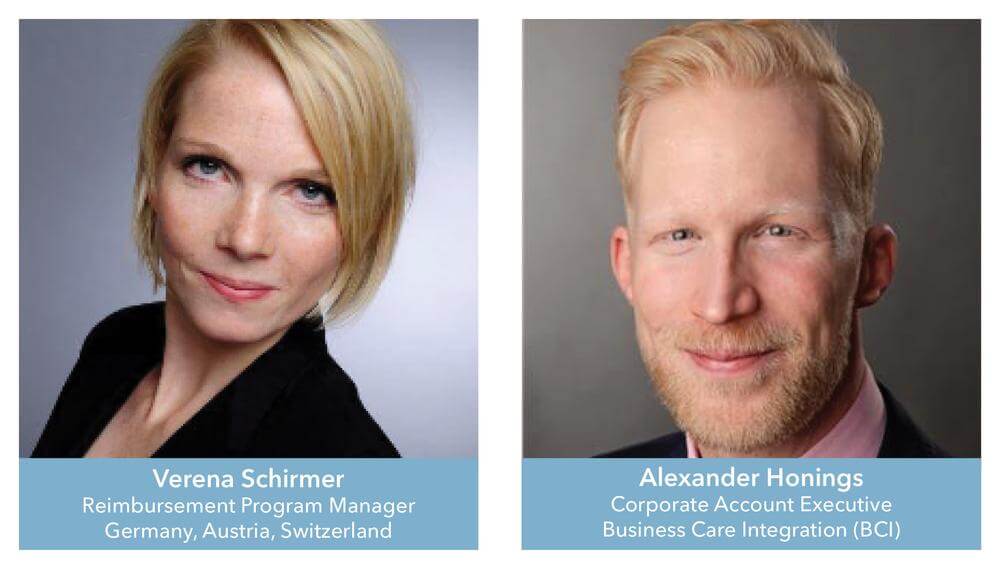
Verena and Alexander functioned as a bridge among different stakeholders within the German healthcare system. The event enabled cross-sharing of information between the administrative and the medical sides of the value chain. Over the last few years, decision-makers in various healthcare systems have changed; procurement operators and payers have become an increasingly active voice in product usage and adoption. In this new scenario, clinicians still need smooth access to the clinically-appropriate devices to treat their patients, but this cannot happen if the right education about reimbursement mechanisms is not in place. This workshop provided an opportunity for Cook to support the process with important education.
Complexity made easy (or… the preparation!)
At Cook, one of our company values is to solve problems together. This workshop is a perfect example of this. In addition to the continuous and strong collaboration between Verena, the Business Care Integration (BCI) team represented by Alexander, and the local Vascular Sales group, many other departments within Cook pulled together to ensure this success.
For starters, Cook did not have a process in place for this type of event. Although there are stringent internal notice timelines required to organize most Cook events, the usual Vista and MedEd contracts wouldn’t work because not all of the external presenters were clinicians. In this regard, Legal also had to play an important role.
A good dose of pragmatism and flexibility from all parts involved not only allowed Cook to organize the workshop in February, but this fast, cross-departmental collaboration also created an improved market-savvy expertise for our internal teams which will be useful in future similar events.
The definition of the target audience, and therefore, of the invitees, was another question that had to be solved before the workshop. In the end, it was decided to target customers, but also to scale the event invitation through existing contacts within several group purchasing organizations (GPOs). Alexander sent out the invite two weeks before the event and the reaction from the audience was remarkable. In the 14 days leading up to the seminar, the interest and acceptance got bigger and bigger, resulting in a 100 external participants.
Clear information…for all audiences
The WebEx-based workshop lasted three hours, during which three speakers shared their knowledge.
• The first presenter was Jan Stana, a Senior Physician in Vascular Surgery at Ludwig Maximilian University (LMU) in Munich, one of Europe’s leading research institutions. He provided insights on the condition of aortic aneurysm, its treatment, and current clinical evidence.
• His presentation was followed by Verena, who took the participants through reimbursement coding best practices as they relate to Cook products. Accurate clinical coding is critical to many areas of healthcare provision. Reimbursement codes are used as the basis of a transparent and consistent payment system, among other things. In other words, understanding the correct codes makes it easier for hospitals to receive the right compensation from the local and national authorities.
• The last talk was given by Dr. Jens-Uwe Füldner from the Medical Controller Reimbursement Institute. He focused on the preparation and implementation of supplementary fee negotiations with health insurance companies.
When medical device companies support customers in reimbursement decisions, this ultimately ensures that each patient gets the correct clinical solution for their pathology. Hence, it was necessary to ensure that all participants, coming from very different pathways within the healthcare world in Germany, understood each speaker’s section of the workshop.
For instance, Verena had to make sure that the first part, which focused on the clinical aspect of implanting stent-grafts to treat aortic aneurysms, was clear to the non-medical attendees. Therefore, many conversations took place before the workshop to clarify the terminology used by Dr. Stana. A similar approach was proposed when it came to Verena’s presentation. Clinicians are not always exposed to the reimbursement code regulations when they implant Cook stent grafts, so she provided several coding scenarios that would clearly describe the diagnoses and the procedures in which Cook devices are used. Dr. Füldner’s content was also shaped to provide complete understanding to the attendees who rarely deal with health insurance claims and negotiations in Germany.
Opportunities and outcomes
For a very long time before the workshop, Alexander had tried to get in touch with Asklepios, a German hospital group. He had offered Cook’s internal knowledge in the negotiations of top-on payments for our aortic technologies, but they did not warm up to his support offer. However, five Asklepios seasoned hospital controllers attended our webinar, and a connection was established.
This was not the only direct outcome after the meeting.
“This workshop brought down silos within the same hospital, in some cases,” Alexander said. “It enabled network opportunities and conversations among the various stakeholders in our country, too.”
The workshop was a very good starting point to reflect the ethical partnership possibilities that could develop between the industry and the healthcare decision-makers.
“We showed German customers that Cook can offer an even broader service to them,” Alexander said. “Through people like Verena, they can get reimbursement guidance and knowledge that will consequently take away the pressure from conversations focused on pricing.”
The definition of customers has changed, and with it, companies will need to adjust. In this value-based healthcare world, no company will be able to bring and keep devices in the market if they only target physicians. Workshops like this can broaden Cook’s reach with healthcare providers and will expand the conversations we will have with them.
“More seminars like this will take place in the future,” Alexander said. “The need is there. New customers have appeared in the MedTech scene. They will continue to demand more than product features. They will want broader support from the manufacturers, such as reimbursement and market access knowledge, in addition to value propositions which will translate product advantages into clinical and economic value along the whole patient pathway. MedTech companies will therefore have to create solutions to adapt to this new environment by broadening the range of support and competencies they can deliver.”