Critical Care hosts second annual Innovator’s Symposium
Innovation doesn’t happen by accident. That’s what seven Critical Care (CC) district managers (DMs) learned at the second annual Innovator’s Symposium run by Todd Englander, business development manager for CC. The event was held at Park 48 and helped participants learn more about the business development process at Cook Medical.
“It was an eye-opening seminar,” said Frank Potucek, a DM for New York. “You get a better sense of the scope and appreciation for the work being done behind the scenes.”
The one-and-a-half-day seminar focused on illustrating how business development managers help develop the framework for the Regulatory Affairs, Engineering, and Marketing work required on each new medical device being commercialized.
“This session helps you realize the enormous impact that a DM or regional manager can have on business development,” said Paul Laczo, a regional manager for the Northeast.
How it works
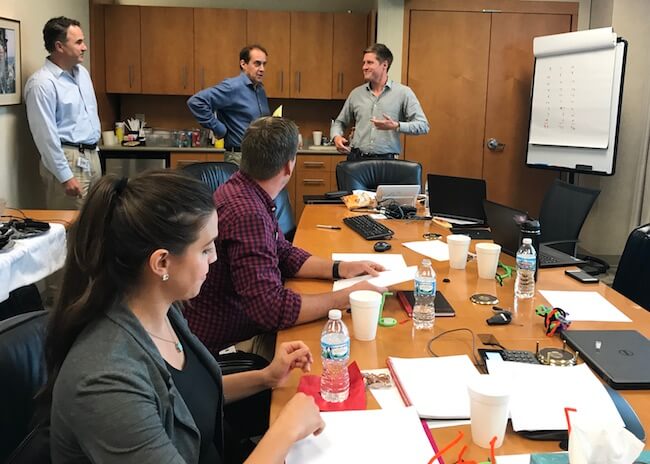
Nine months prior to attending the symposium, the seven DMs were grouped into three Innovation and Discovery Teams. The teams were tasked with investigating a problem within the scope of the CC specialty and creating a new medical device, service, or process that can help solve the problem. With the assistance of a mentor and formal education sessions, each team created its own solution. Monthly conference calls and brainstorming sessions took place leading up to the symposium.
In the fall, the teams went head-to-head at the symposium, which was inspired by the hit television show Shark Tank. These would-be entrepreneurs took a crack at convincing the room that they had the next great Cook product. The ideas presented focused on CC’s procedural areas, including airway management, centesis and drainage, and endobronchial ultrasound.
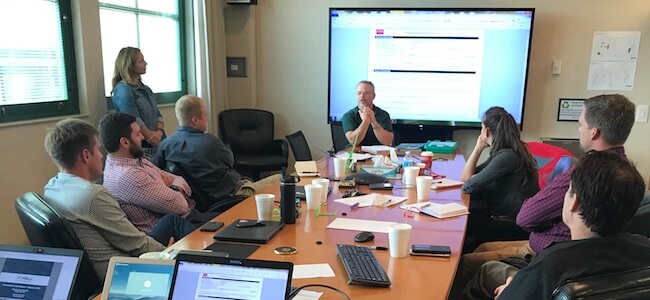
After one team was voted out by a panel of judges, two teams remained in the competition. Now, their job is to follow their idea through Cook’s product development process. The teams will work with several different functions, including Marketing, Engineering, and Operations, in order to bring their ideas to life.
However, in order to continue moving their ideas toward commercialization, they must present their progress in a competition against two new teams at next year’s Innovator’s Symposium. If either of their ideas is beaten by another team’s idea, the new team gets a shot at presenting their idea the following year. The competition continues until one team commercializes their idea.
What participants learned
John Wallace, a DM for Indiana, participated in the pilot symposium last year and said he hoped to use this new-found knowledge in the field. “The take-away for me was how to have more productive conversations about innovation with my clinicians, which shows how Cook can provide another layer of value to them,” said John.
Emily Watkins, a DM for California, wanted to see the inner workings of Cook business development process. She said she felt that participating in the Innovator’s Symposium had “enlightened [her] to the multitude of people and processes involved in evaluating and potentially commercializing a product idea.”
After the symposium, all the DMs said they now better understood the importance of how business development works with Regulatory Affairs, Engineering, and Marketing—no process is an island. Many Cook functions must work together in order for business development to be successful.
“Cook wouldn’t be as successful as it is today with just product iterations,” said Andrew Conder, director of global product management for CC. “We need to continue to develop new ideas that take products and procedures much further.”
Very interesting, encouraging, constructive, worthwile to be copied, excellent, I am really curious about the continuation!
This is awesome!
Good job CC team!
I am more than curious about the possibility of innovative growth in Cook Critical Care. I was misdiagnosed for five days (which is statistically fatal) at Bloomington Hospital in 2001. Dr. Banach took on my case (hypertryglyceridemia), masterfully managed it, and I recovered and left the hospital after 26 days. I have the utmost respect for Critical Care Medicine. Dr. Banach has just been hired as Hospitalist to manage all of the physicians who work for IU Health Bloomington Hospital. He was the first administrator of Volunteers in Medicine here in Monroe County. He has an insatiable motivation to save patients’ lives. If I were seeking innovative new directions in Critical Care Medicine, a conversation with such a physician could be of immense value.
If anyone is interested in joining next year’s Innovation Group contact the group leader @ John.wallace@cookmedical.com.
Love the idea…excellent work CC!!! Hope to see some of the concepts soon…