A momentous milestone
Cook Australia implements patient implant cards
As part of the 2021 Business Plan, Cook Australia initiated a business improvement project (BIP) to address changes to our labelling system and product labels. The objective of the BIP was to improve labelling capabilities and support our business to meet a new Australian regulatory requirement, which is the inclusion of an implant card with our implantable products.
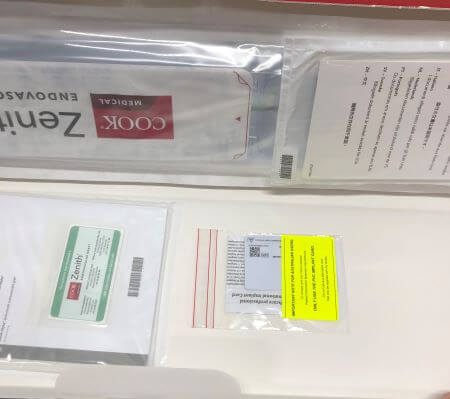
The implant card is a PVC card, like a credit card, which has been designed specifically for patients. As of December 2021, patients within Australia who receive an implantable medical device will be required to also receive an implant card. The card has a link to a website which patients can access to obtain information about that device. For example, the product code, what the device is, what it is made of, and what adverse events can occur. As the implant card is an Australian regulatory requirement, every implantable Cook product sold is required to be distributed with one.
Completing the BIP
Completing this BIP wasn’t as simple as just printing out a card and placing it in the packaging for each device. A new labeling system had to be established, which necessitated a heavy lift by the IT and Documentation teams, as well as collaboration from many other groups within Cook.
The successful completion of this BIP required cross-functional collaboration amongst Regulatory Affairs, Quality Assurance, Purchasing, Supplier Quality, Post-Market Engineering, and Sustaining Engineering.
“With about 40 people involved, the project has come to fruition after almost 18 months,” said David Peeler, a project manager.
“We achieved a major milestone at the end of October, when we completed our side of the project and made sure a software and printing system was successfully created. We printed everything in house, and that required the expertise of several teams. Even our zipper bags that the implant cards will go in needed to meet certain requirements,” David continued.
Karen Harris and Nannette Lewis, both from Documentation, expanded on the extent of work done by their team.
“Everything was regulated and checked,” Karen said. “It was a multistep process. We were responsible for getting all real product numbers (RPNs) that were available for sale in Australia into the new labeling software system so we could meet the regulatory requirements for the new implant cards.”
“We made sure that we were able to transfer all the necessary data into the new system, and we had a lot of input from the US team as well,” Nannette added. “There were quite a few hurdles to get through. Some of the information and data didn’t line up with what our counterparts in Europe had, so that kind of set us back, but each challenge we faced, we faced as a team.”
“You’re only as good as your team, and we had a wonderful team,” Karen said.
The responsiveness of the Documentation team made things easier for David as a project manager. They gave him insight into all the documents in the product life cycle management (PLM) system and made sure he was up to date with everything being approved.
“They did an excellent job,” he said. “I wouldn’t have known what was happening without them.”
Peter Healey, IT location manager at Cook Australia, coordinated the new systems and made sure there were no issues.
“My team of three helped out with the programs in our manufacturing system, and we worked with the Documentation team as well,” he explained. “There were a lot of different meetings and we were on a bit of a time crunch, but we made it happen, thanks to David’s excellent communication skills.”
“It was pure teamwork,” David added. “We were running a tiny bit behind schedule, and during the last week before our deadline we came across quite a few issues. Never in my 21 years of work experience have I encountered so many issues so close to the deadline. But we managed to fix them and hit the deadline.”
The teamwork was all the more impressive because several of the departments have been working remotely due to COVID-19 restrictions for almost the entirety of the project. David suggested that working from home proved to be a little advantageous, as everyone in the project team was more responsive toward emails and messages.
Just the beginning
While David’s team may have hit the manufacturing deadline in October, completing a major milestone, the work for this project was far from over.
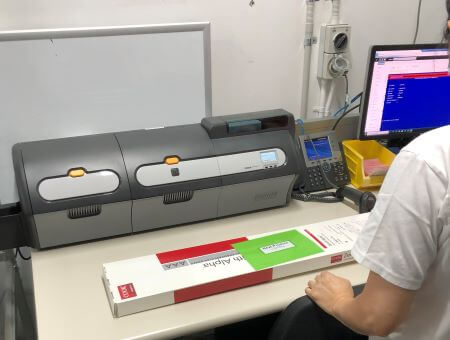
Other global Cook manufacturers were also implementing the same new labeling system, on the same timeline as Cook Australia. By November, almost all manufacturers had established the system and generated the new implant card template within it. Once a “go live” message was received by the CSD team, they could then begin the monumental task of adding the implant card to all implantable products in the AUDC warehouse. This “stock on hand” labeling project involved extensive quality planning, a new process, testing, new equipment, a new team, and a new labeling workstation within the AUDC.
Mick Van Der Maat, supply chain manager, began working on this project in March of 2021 to make sure the AUDC was ready to label their stock on hand as quickly as possible, to minimize disruption of supply to our Australian customers.
“We’ve had a lot of work to do, and there have definitely been many challenges,” Mick said. “We have to add an implant card to stock from all the Cook manufacturing entities, not just Australia.”
The AUDC will continue working on this project throughout 2022.
At this stage, local and global collaboration—along with a bit of sweat—have helped us maintain supply of Cook products to our Australian customers with minimal disruption.
A huge congratulations to the teams that were part of the implant card project for achieving such a momentous milestone!
For more stories