A lifelong connection is formed between Paula Culliton’s family
and the three Ukrainian refugees they took in
For Paula Culliton and her family in Dresden, Germany, the idea of taking in a family of Ukrainians was something that they had considered from the beginning of the war. However, this idea quickly became a reality when they took in a family of three Ukrainian refugees on March 24. This interview was done on May 10.
What is required in your area/country to bring in a family of Ukrainians? Could you please describe the process?
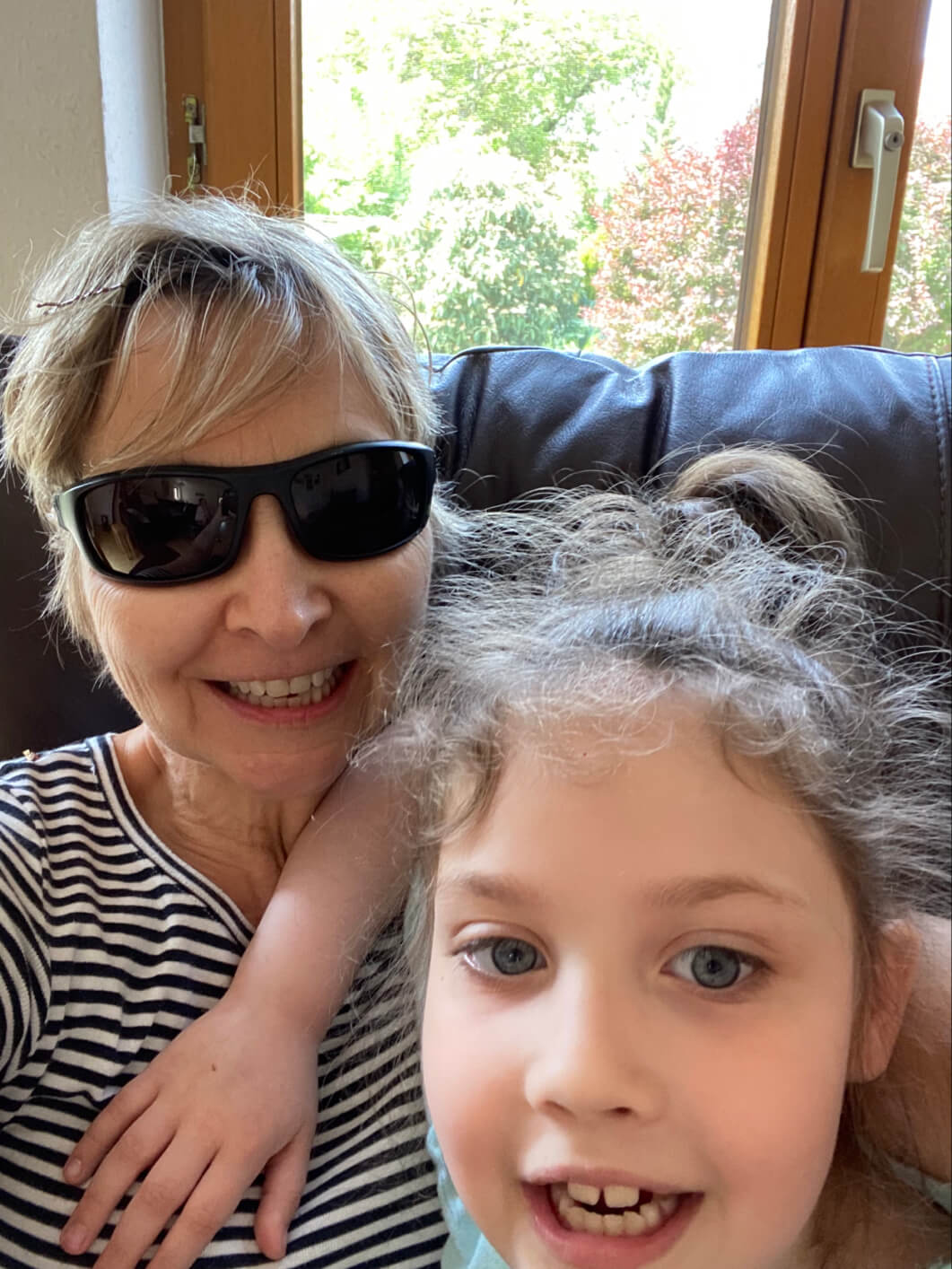
Paula Culliton (director, Global Continuous Improvement for Global Supply Chain) and Sascha, one of the Ukrainian refugees Paula’s family took in.
There are a few pathways that I am aware of, but the process might have changed since the beginning of the conflict at the end of February, considering the complexity of the whole situation and the fast-growing crisis. About 6-8 weeks ago, there were many people fleeing Ukraine, and since then, the German states have been facilitating their arrival in Germany. In the first phase of the war, these federal states gave them accommodation in large centers, such as sport halls and conference venues. Besides this option, smaller secular charity agencies and church communities across the country have become increasingly important, too. I live in Dresden, on the east side of Germany, so from a geographical standpoint, my city–like Berlin– became one of the first ports of call to welcome the Ukrainians in my country.
Since the war broke out, my family and I had been very aware of what was happening in Ukraine and talked about bringing someone into our home. Donating money to non-governmental organizations was not enough for us anymore.
Why have you and your family made this decision? Is this something you always wanted to do?
Social studies say that the happiest people are those working in the community and giving back to the community.
However, I was actually never one of those people because I kept on changing communities, and I always traveled so much. Some time ago, when I relocated to Germany from Ireland, I did a vision board as part of a culture course and one of the points was to get involved in some sort of volunteering activity. I thought I’d teach English in one of the children’s homes here in the area, a 10-minute walk from my home. I never did it. I went from doing zero charity work to welcoming a family of Ukrainians!
Our link to the refugee support organizations came through Anya, my 18-year-old daughter. The father of one of her good friends is a pastor in a non-state-funded religious organization, which has been coordinating the arrival of Ukrainian refugees for a while. Our request to welcome someone in became reality within a week, although we are not part of any church.
What were your thoughts and emotions at that point in time?
It went from concept to reality extremely fast. Ulrika, one of the church community workers, reached out to me and told me that we had been approved to take in a family of Ukrainian citizens. My husband Kevin was in Ireland that week visiting his family, so the first step was to let him about this development. I then talked to Anya and explained to her that we did not know how long the Ukrainian family would stay with us. We had no timeline at that moment.
The emotional roller coaster I certainly went through at that point was significant. Every fear I had surfaced and before they arrived, I’d went to bed every night processing these doubts. It was a Forrest Gump kind of phase, you know, “Life is like a box of chocolates. You never know what you are going to get.” Whoever would stay with us were complete strangers.
And then, all these worries would completely disappear the following morning. These emotions were nothing compared to what these millions of people were feeling while they continued to flee cities that were under bombardment. I also considered that these Ukrainian citizens would not know where they would end up either.
I knew my family and I could give them shelter, warmth, and food first. Besides, the pandemic made me more aware of resilience and that people seek and need hope. So, since the first weeks of this experience, I tried my best to give them courage, too. I told them that they were safe here with us and that they could have a good life with our family, in Germany. That’s the only approach I could take.
Could you tell our readers about the people you have taken in?
We have taken in three people. They come from the Donetsk Oblast in Eastern Ukraine. It is the most populous and most densely populated region of the country and has been one of the most severely and dramatically impacted areas by the war. Katya is a full-time mother. She arrived with David, her 16-year-old son, and Alexandra (known as Sascha), who is 6 and on spectrum, as in she has been diagnosed with autism. They left their city at the outbreak of the conflict and traveled by train for four days, first to the Polish border, through Warsaw, and then they got to Dresden.
Did you make any changes to your home for their arrival?
German houses often have rooms in the basement. The only space we could offer them was in that part of our house, as it was the largest (20 square meters). I felt awful when they got here, because before fleeing their home, they spent a month in an underground bunker, and before that, they had been ill, so they were actually indoors for six weeks in total. We could not do anything else. Kevin’s office studio and Anya’s bedroom are smaller. At the beginning, they would not come out of their room for longer periods, unless they had to use the bathroom or to prepare food in our kitchen. Then, Katya told me that they felt safe in the underground space.
From the very early stage of this experience, my family and I became extremely conscious of noises. Even airplanes in the sky scared them. Moreover, every Wednesday afternoon at 3:00 pm there is a fire drill siren that goes off in our building. Anya and I sat them down and explained that it would only last a few minutes and it was simply a routine safety procedure.
How did you communicate?
We have no common language. Communication was—and still at times is—tricky. Katya knows a small bit of English, which has improved since she got to Dresden. Nevertheless, if we need to talk about complex tasks to be done, we use Google Translate. If they decide that they want to remain in Germany, they know that learning German is critical.
On what else did they need help?
As I said earlier in the interview, I took a practical approach in my attempt to meet their needs. I personally had to block out all the news coming out of Ukraine as it was extremely upsetting. I focused on being there in the moment for them.
First, for Katya to have agency over their lives was important. I showed them the family kitchen and we went to the supermarket together. We also supported them financially for the first three weeks until they received emergency support from the state. Around the second week, though, Katya anxiously approached me and asked me if she owed us this money back. I felt terrible because I realized I should have told her that this was a gift, and she could put her mind at ease.
They also needed help with the official processes. We worked together to set up their residence permits, community registration, a bank account, state support, schools, accommodation, and medical insurance.
Across these administrative tasks, I was also exposed to overworked employees from the various state agencies. The vast numbers of refugees coming into the regions created significant work for the authorities. But they were always helpful, and considerate of the fact that I was navigating this in my second language. I think this is another important aspect to underline in this whole experience. There were times when I felt completely overwhelmed. Katya was always so grateful for our help. It kept me motivated to keep going.
Where and when I could, I involved Katya. I thought it was important to give her some agency also around practical day-to-day steps. I hope it also gave her some sense of independence and normalcy.
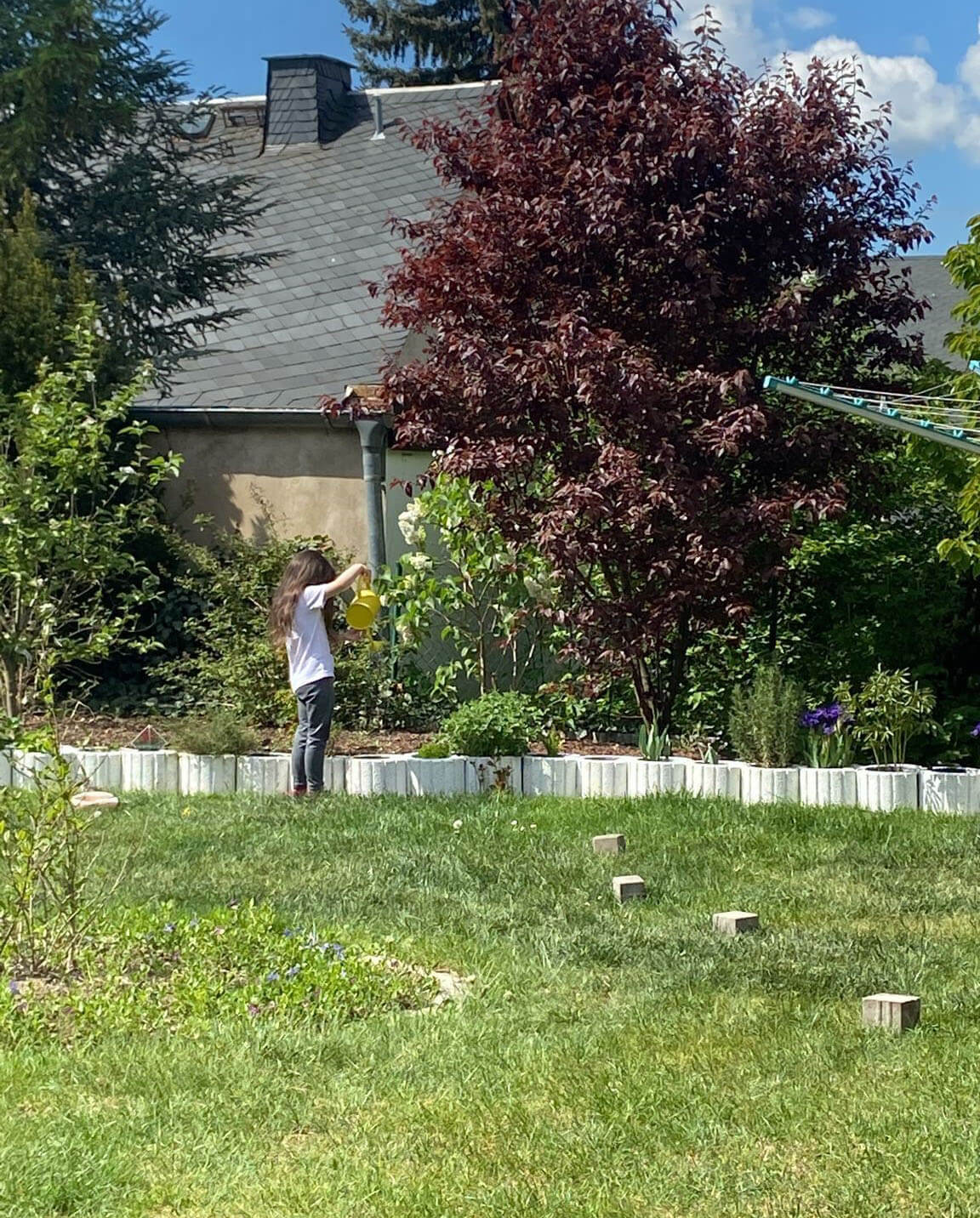
Sascha watering the garden at Paula’s home in Dresden, Germany.
We are now looking for an apartment, as a 20-square-meter room is not enough in the long term. David is a teenager and needs his own space, too. It has not been easy to find a suitable place, but one step at a time.
How is Sascha dealing with the situation?
Sascha has been diagnosed with autism, and after the first weeks, Katya began to be concerned about her. She would try to get her out in the fresh air with the arrival of spring in Europe, but because of the unfamiliarity of everything, she was at times very overwhelmed. Sascha was understandably traumatized, and it was coming out in not wanting to do anything. Katya sometimes struggled to bring her back home from their walk.
I reached out to Ulrika again to see if we could do something for Sascha. It got the ball rolling. They were able to get an assessment in terms of where she sits on the spectrum. She now has access to the autism clinic where the plan is to get her intensive help to get her integrated into the school system. Before they fled their country, they were receiving similar support, but it all disappeared.
How’s David reacting to his new life?
When David left Ukraine, he was in the process of finishing secondary-level school. He was in the 9th class, which entails final exams. That never happened. He is now going to an equivalent school, where he can finish out his Ukrainian school program. He started it two weeks ago and they set up a class with other Ukrainian teenagers. He loves it and he is also learning German.
Do you have a final snapshot to leave our readers with?
I can tell you that Katya’s family is now comfortable with us. Sascha is enjoying playing the piano and checking out books from our bookshelves, and she sometimes over waters our garden. A couple of days ago, she pointed at me and asked her mum if “babushka” was going on a walk with them. She thinks I am her grandma, and it makes perfect sense: I am 56 and she is 6. I must look ancient in her eyes.
I will accept this nickname with all the love in the world, and I hope there will always be a connection between my family and them.
*An update from Paula as of July 7*
Katya and family are moving out mid-July. We have found an apartment and all the state support has been set up for her and her children. Sascha has a place in a school, which will help with her autism diagnosis. David is going to finish his secondary school education and Katya plans to take a course to learn German.
For more stories
48 Comments
Thank you for sharing your story. This is the time of life when we need to hear that people still care and are willing to share.
Amazing story Paula! Well done to you, Kevin and Anya for your kindness and support to this family.
“Sometimes it takes only one act of kindness and caring to change a person’s life.”
You’re right, Andrea! Paula’s heart is so big and it was a great honour to write about her efforts!
This is such an inspiring story to share. How wonderful to hear you made a choice to step up with open arms & help this family. Very heart warming and I am certain they will be forever thankful.
Thanks, Paula, for your heart to help. You were able to overcome your fears and make personal sacrifices in order to help others, which is very inspiring. Glad the family is doing well. Thank you, Vanessa, for sharing this story.
Thank you for sharing your story. This is the time of life when we need to hear that people still care and are willing to share.
Thank you, Pamela!
Well done Paula. What a wonderful story you should be very proud of your efforts.
Thanks a lot, Jonathan!
Well Done to you Paula for sharing this story!
Fabulous support for a family in their time of need.
Thanks very much, Matt!
Fantastic! All my best wishes and thank you for sharing this story Paula.
Thank you, Susanne!
Incredible! <3 Bless you all.
Thanks, Melissa!
Amazing story Paula! Well done to you, Kevin and Anya for your kindness and support to this family.
“Sometimes it takes only one act of kindness and caring to change a person’s life.”
Thanks a million, dear Imelda!
Thanks for sharing your story Paula. Amazing kindness and generosity from you and your family.
Thanks, Olive! I’ll make sure Paula reads all these lovely words!
Thanks for sharing Paula and most of all for helping Katya and her kids. It is a touching story
Muchas gracias por tus amables comentarios, Cristina.
This story warms my heart. Thank you for sharing, as well as being a force for good in this world!
Thanks, Jason!
Well done Paula, Kevin & Anya, such admiration for your hospitality, generosity & kindness to strangers. Warmed my heart to read this.
Such an inspiration indeed. Thanks, Ruth, I hope you are keeping well!
Your heart and thoughtfulness are admirable. Thank you for your act of kindness and thank you for sharing your story!
Thank you, Kara!
What a beautiful and amazing kindest you have shown Paula. So lovely to read.
Couldn’t agree more, Antoinette!
What a beautiful story of love and kindness. Thank you for helping this Ukranian family!
Many thanks for your kind words, Shirley!
Paula, a heartfelt thank you to you and your family for opening your home to this family in such great need.
You’re right, Andrea! Paula’s heart is so big and it was a great honour to write about her efforts!
This is such an inspiring story to share. How wonderful to hear you made a choice to step up with open arms & help this family. Very heart warming and I am certain they will be forever thankful.
Thanks, Bridget!
What a human thing to do..very generous and life changing for all. Well done Paula
Thanks a lot, Zoe!
Wow thanks for sharing this wonderful story. Your kindness will always be remembered by this family. Inspirational !
We need more acts of kindness like Paula’s
Paula you are a beautiful soul. I am blessed to know you.
Thank you, April!
Paula, what a beautiful way to make a difference, and be a force for good in the world. Thank you for sharing your journey.
Absolutely agree, Todd!
What a great act of kindness!! Hats off to you and your family Paula.
Thank you, Ross!
Amazing Paula, such a beautiful story, the support you have provided to this family is invaluable and I am sure it will never be forgotten!
Grazie Romy! 🙂
Thanks, Paula, for your heart to help. You were able to overcome your fears and make personal sacrifices in order to help others, which is very inspiring. Glad the family is doing well. Thank you, Vanessa, for sharing this story.
It was such a great chance to be able to tell Paula’s story, Jeremiah!
This is a lovely story of human kindness and connection. Well done to you and your family Paula. What a beautiful photo of Paula and Sascha 🙂
Thanks, Deirdre. I will make sure that Paula sees all these comments!
Well done Paula on doing this. It was a really lovely heartwarming story. and I hope they will be able to return home soon.
Thanks, Georgina. It was a great honour to tell Paula’s story!