Creating connections to move from reactive to proactive
Cook partners with Atex on launch of pilot SRM
When Cook’s Brand Essence, “Relentlessly inventive, deeply connected,” was unveiled last September, it immediately resonated with Autumn Weber, senior director for Global Procurement.
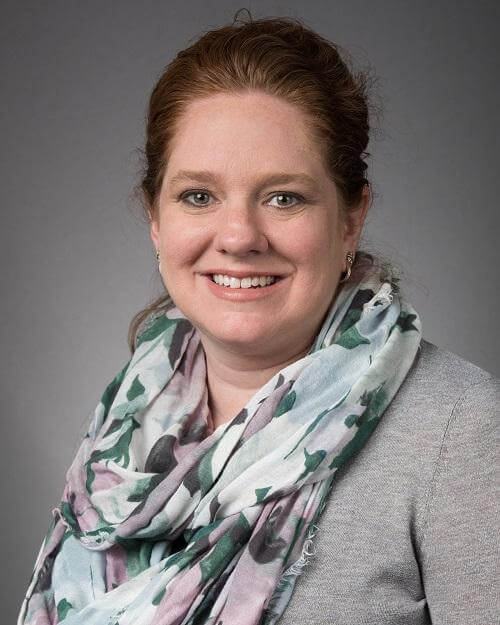
“I discussed with Ross Harvey (vice president of Global Supply Chain), that I thought this is perfect timing for setting up a supplier relationship management program (SRM),” Autumn said. “An SRM would help us get that deeper connection with suppliers—and it also helps us get a deeper connection within our internal teams on how we’re working with those suppliers. We also met with Gartner (a research and consulting firm that Cook has partnered with on many projects over the last 10 years) to ensure we were putting in a best practice program for Cook. We are always looking to improve our Procurement principles and relying on a partner like Gartner for feedback ensures we are moving in the right direction.
“I started talking to him about how I ran an SRM program at my previous organizations and asked him if he thought Cook was ready for this?” she continued. “We decided that in 2023 we were going to make this change for Cook and we think it’s going to be successful to help build out those deeper connections.”
Fast forward nine months to this June, and Cook has launched a pilot SRM partnership with Atex, a long-time Cook supplier of materials used in stent graft production.
What is “ready”?
The obvious question is what was it that made Cook “ready” to build an SRM program? According to Autumn, there are several reasons that “now” was the right time.
The first step was the creation of the Global Procurement team in 2020. Prior to that, every Cook manufacturing facility handled their own procurement—often dealing with the same suppliers as other Cook companies.
“Having global overview allowed us to understand which suppliers were impacting multiple entities,” Autumn said.
Additionally, over the next two years, the Procurement function brought on global category managers and did a segmentation of Cook’s current suppliers. At that point, the team started taking a long look at those companies with which Cook was working.
“We wanted to know who our top suppliers are in terms of not just spend, but also in terms of risk revenue—how much of our revenue do they impact?” Autumn said. “Are they sole source, single source, or a dual source supplier? Are they working on R&D (research and development)? Are they an innovative supplier with us? Do we see ourselves growing with them in the future in terms of them bringing new technologies and us collaborating on technologies for the future?”
Autumn and her team spent a year observing and documenting these relationships, gaining a deeper understanding of how we worked with each of them.
“Then we put it all together and started our supplier relationship management program with what we call our ‘strategic’ or ‘critical’ suppliers,” she said.
Transitioning from transactional
While Cook and Atex have worked together for years, according to Autumn, interactions between the two companies have mostly been transactional.
“We would release a purchase order, we would buy graft material from them, they would ship it, and that was the relationship,” she explained. “They’ve been a very good supplier for us for many years, but it wasn’t a relationship where we were necessarily thinking about strategy, or into the future, or how do we collaborate?”
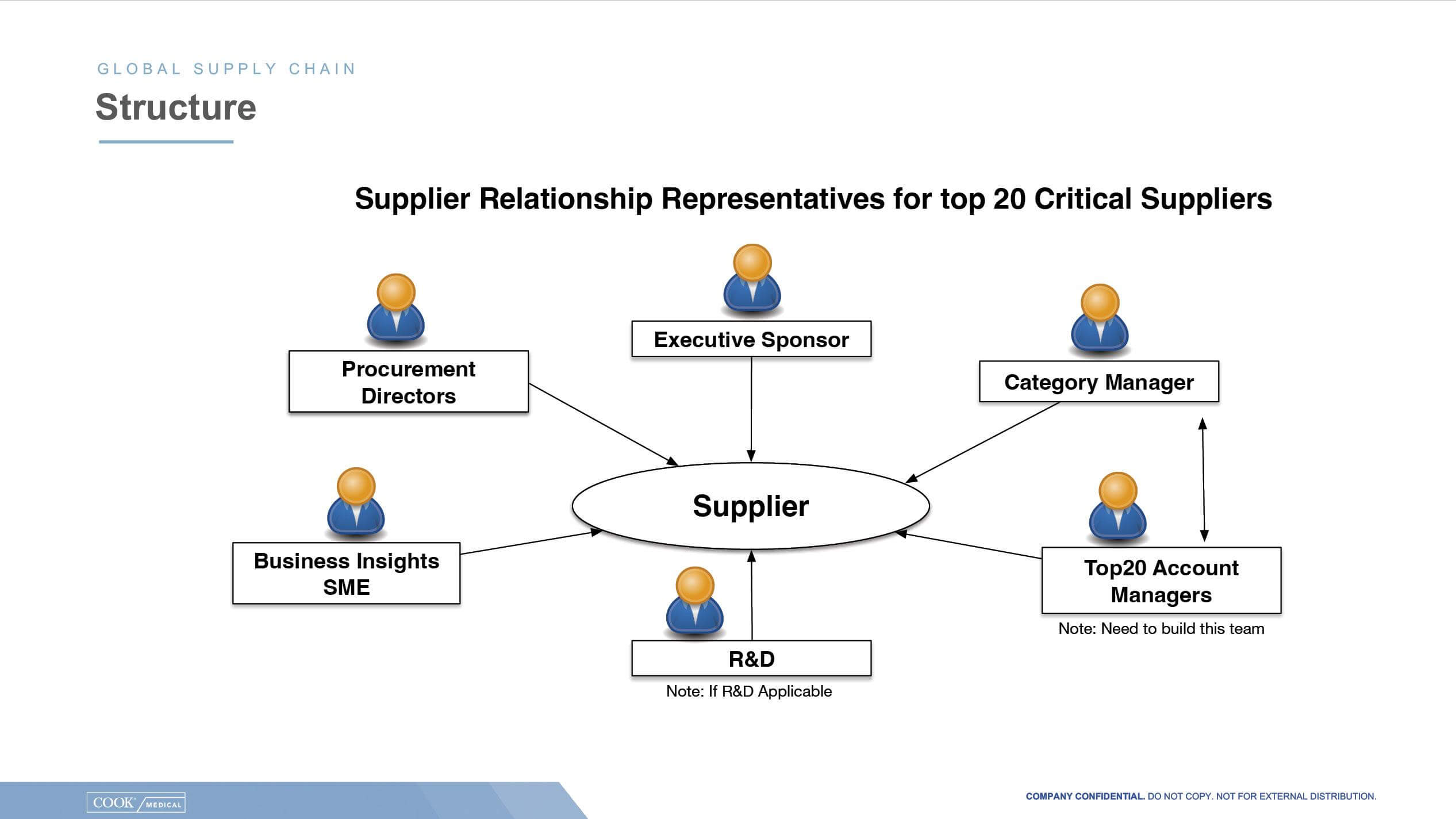
Now, as part of the SRM program, six touch points have been established between a variety of roles at a variety of levels from both companies.
These include, from Procurement:
– An accounts manager
– A global category manager
– Procurement director
From outside Procurement:
– An R&D or technical lead
– A postmarket business insights leader
– An executive sponsor
(See the gallery below from details about these roles).
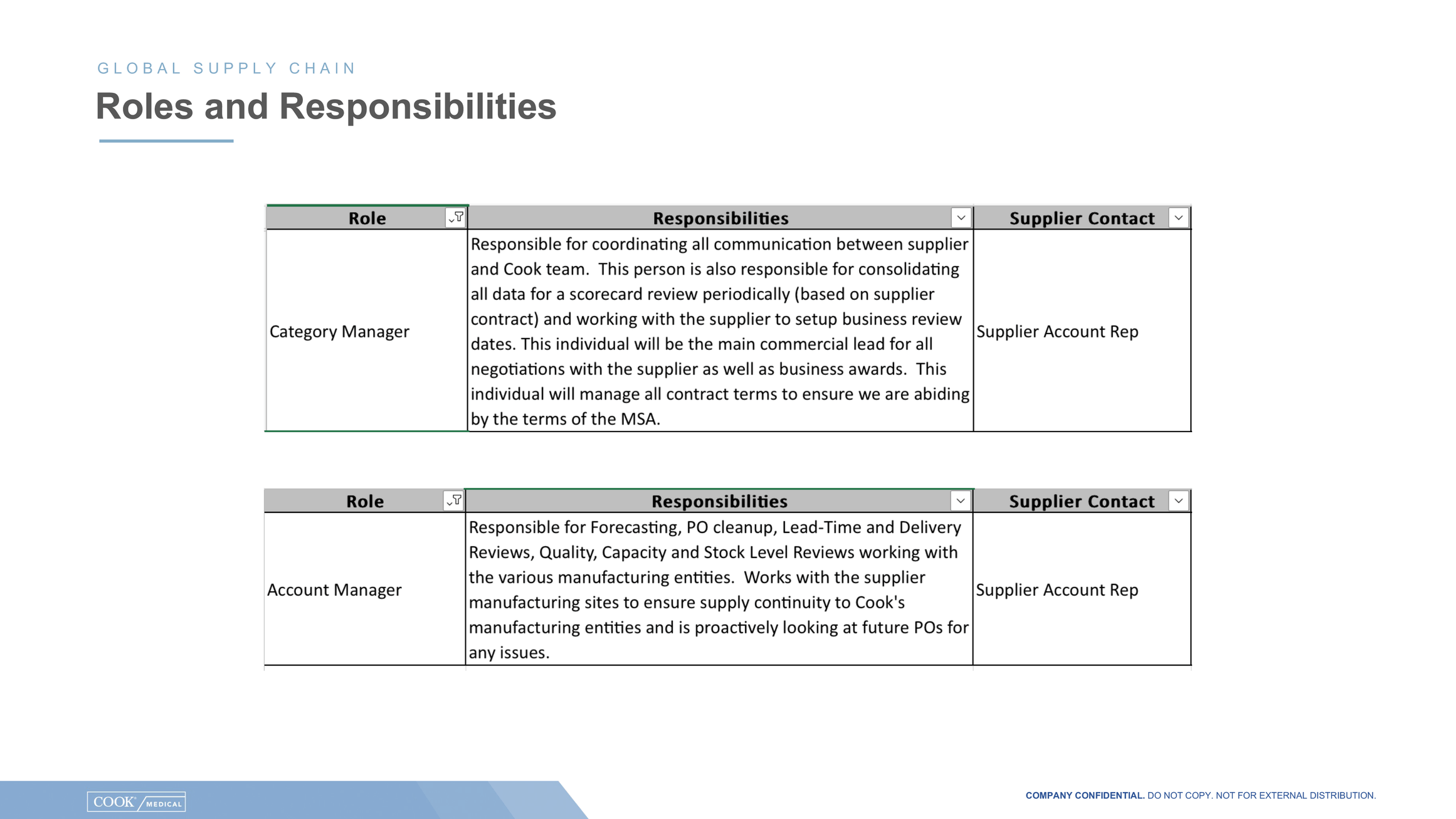
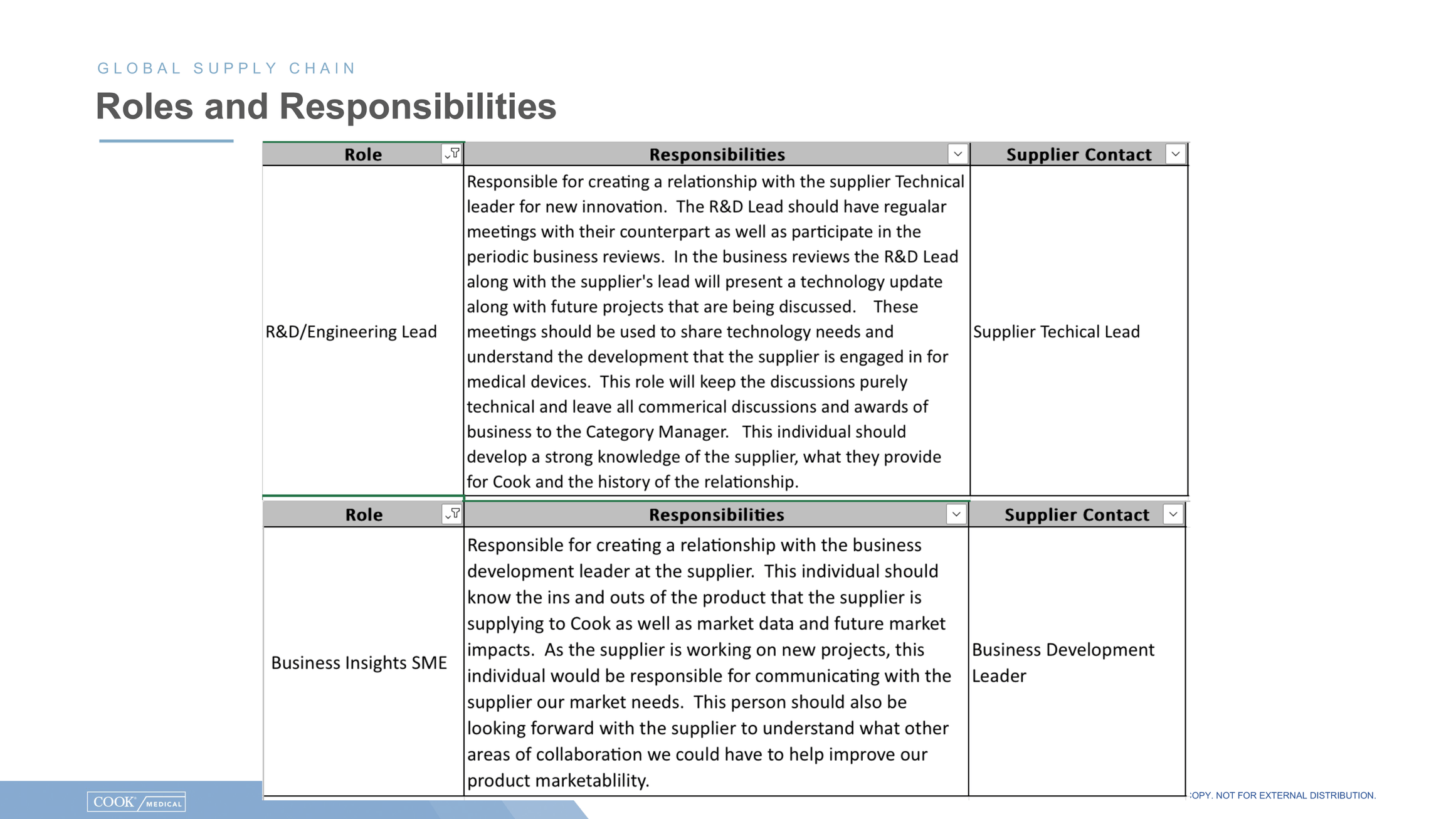
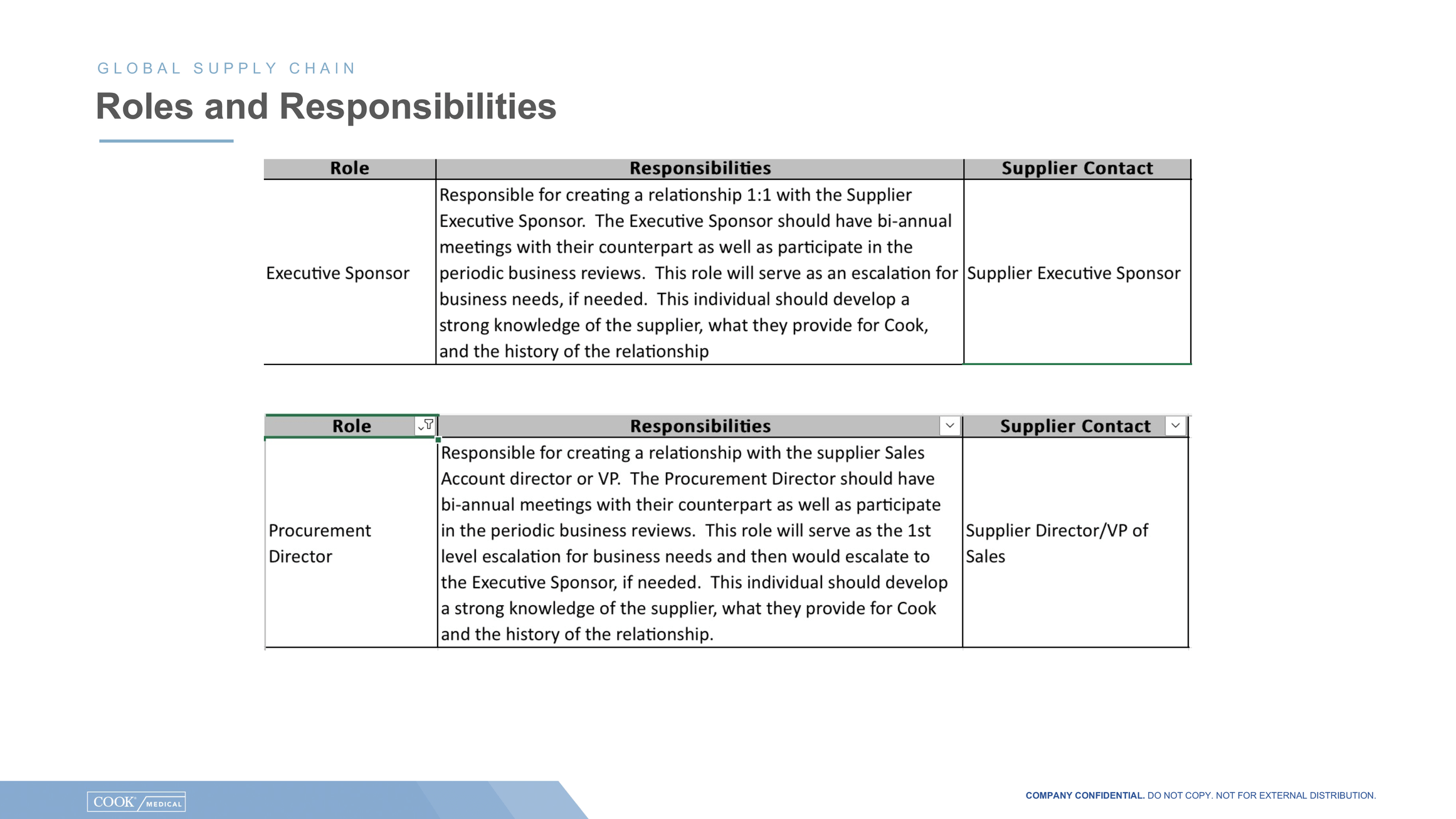
All of the above stakeholders will join together for quarterly business reviews.
– Every other quarter those business reviews will be in person and will be longer meetings where each of those individuals will be present and each area will do a report out.
– The other two quarters, the group will have an hour touch-base phone call, just to stay connected.
In between the quarterly meetings, the Cook representatives will be meeting more frequently with their Atex counterparts to build those relationships and understand what’s going on with the business from both sides.
An additional connection point between both organizations will be a yearly “voice of the supplier” survey that will be run by Gartner. Up to 10 different people from a supplier’s organization will be asked to give feedback on Cook. Gartner will then provide Cook with a report out on the responses.
“We give scorecards to tell them how they’re doing as a supplier to us, but this is us getting that scorecard of how are we doing as a customer,” Autumn said. “Where do we have gaps? Where do we have pain points? Where are we doing things well? Over the years you’ll start being able to see that if numbers start dropping in one area or another, you realize proactively we might have a problem. Then we can focus on that area and figure out we can get that number back up.”
Relentlessly inventive?
SRMs are not a new construct in the business world. Before coming to Cook, Autumn spent 16 years in the automotive industry, and worked with SRMs there from day one.
Yet she still sees the creation of an SRM at Cook as an example of being “Relentlessly inventive, deeply connected.”
“Where I think that we’re being inventive is for the first time Cook is looking at procurement from a global perspective,” Autumn said. “We’re taking the needs of all of our different manufacturing entities and are able to leverage that under one supplier relationship management, so that we can meet the needs of everybody. In the past, some entities were maybe getting better situations from suppliers. Having that global view, and pulling everybody in the process is not inventive, but changing the way we think about our structure and our collaboration is being more inventive and really driving that deeper connection.”
What is success?
Cook works with over 2,500 vendors, but the top 150 make up 80% of our spending. The goal is eventually have Cook’s top 20-30 vendors, those “critical” or “strategic” suppliers mentioned earlier, rolled into the SRM. In addition to Atex, the plan is to have one to two more vendors enrolled by the end of 2023.
In theory and on paper, the SRM sounds like a great idea. But it needs to work in the real world—and to know if it’s working you have to have parameters in place, goals to hit, to prove that it’s actually making a difference in Cook’s ability to obtain materials needed to build product for patients around the world.
“To me, the success of a SRM program is moving our dial from being reactive of dealing with issues that have occurred to being proactive and getting in front of those issues,” Autumn said. “There’s always going to be supply disruptions that come up. There’s always going to be a transportation issue that gets a raw material to the supplier late. There’s always going to be a machine that goes down or a tool that breaks. So I can’t say that success is no supply disruptions because that’s just not realistic in our world. It’s how we handle those. If we’re handling those in a proactive manner, where they’re coming to us early and we’re working together as to what that solution might be so that we don’t have a gap—that is success.”


katana
My first job out of graduate school was managing suppliers for the consumer inkjet business of a large printer company. We followed the same model, and I am excited to see it implemented at Cook. It is hard work, but it will make our supply chain more robust and improve our bottom line.