A shining example of renewable energy
Solar arrays brighten a sustainable future at Cook’s headquarters
They traveled by steam ship and by semi-trailer truck across the globe to settle in Bloomington, Indiana. The journey began in Kolkata, India. Over 3,000 solar panels were carefully bundled in crates and loaded onto a steam ship to be transported to Norfolk, Virginia. The shipment went through customs in Norfolk, and the crates were unloaded and packed into a truck for the final leg of the trip to Bloomington. Almost a month after the start of the voyage, the solar panels arrived at the Profile Park facility to be stored until they are ready to be installed.
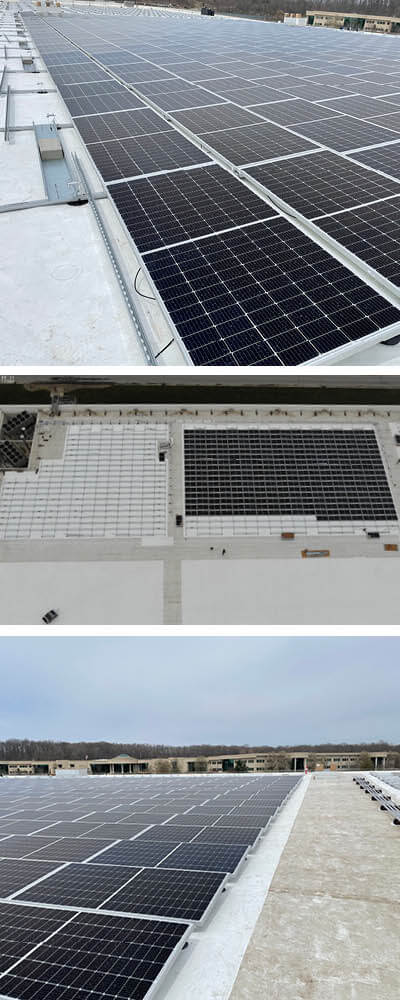
Many of the solar panels have already made their way on flatbed trucks from Profile Park to the AMER DC facility for installation. Approximately 1,620 panels will eventually cover the entire roof of the AMER DC facility, which is located a short walking distance from Park 48, Cook’s world headquarters in Bloomington. Massive telehandler forklifts, which are specially designed to lift loads without moving the base of the forklift forward or backward and with a lift capable of reaching the AMER DC roof, awaited the solar panel shipment. The solar panels are being slowly lifted to the roof by the forklift and unloaded by hand. Installation for the AMER DC is scheduled to be complete by the end of May.
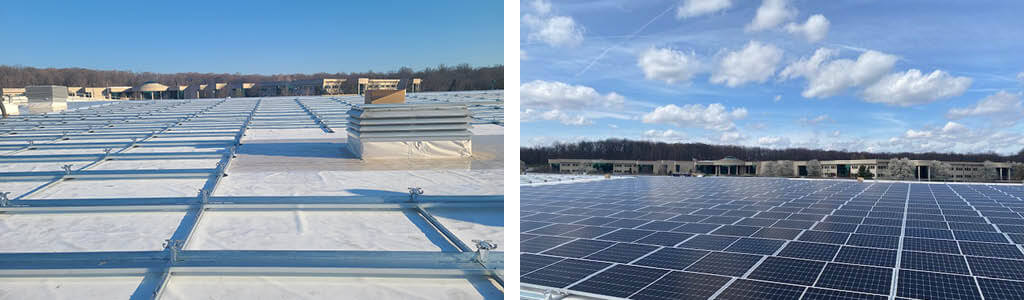
The solar panel installation at Park 48 includes Building D (1,248 panels) and E (606 panels). With a much higher roof pitch than the AMER DC, a crane has been set in place to lift the solar panels to roof height to be unloaded by hand. The deadline for the Park 48 installation is set for the end of June. If the project is completed on deadline, Cook may receive a significant tax incentive from Duke, the local power company.
Why solar panels?
“The benefit of pursuing solar panels is the use of renewable energy, which reduces our carbon footprint,” explained Erin Kunkel, Corporate Social Responsibility manager.
The term “carbon footprint” refers to the amount of greenhouse gases that a person or group produces in the course of operations. By installing solar arrays, Cook will reduce our carbon footprint and turn unused rooftops into a source of clean energy for the facility. When we use renewable energy, like solar or wind, energy comes from the sun or natural processes that regenerate naturally. Traditional energy production burns fuel and generates pollution. So, the less traditional energy we use in our operations, the better our carbon footprint will be. Renewable energy helps to improve our environmental performance.
The solar panel initiative not only reduces our carbon footprint and saves the company money on the utility side, it also serves as a strong example of how Cook is working to help the environment.
For the AMER DC facility, the solar panels will eventually offset energy almost 50% of the site’s energy costs, and for Park 48, the total energy bill will be offset by 15% to 20%. The cost of installing the solar panels is a hard project cost, but the return on investment (ROI), the amount of time it takes those savings to equal the cost of the project, is typically within five to ten years.
“The cost of energy is going up; even in Indiana where the cost of coal-derived energy is relatively low, the market is starting to climb,” said Erin. “So our energy bills could be going up in the future. That would make our ROI on renewable energy projects even quicker.”
Going solar makes a difference
• At AMER DC, the one-year carbon offset is equivalent to 1,335,800 miles driven by a passenger car.
• At Park 48, the one-year carbon offset is equivalent to the electric usage in 107 homes for one year.
The planning process
During the planning process for the solar installation, there were some nuances for such a large environmental project for the Cook headquarters.
In the beginning stages, structural engineers reviewed the buildings to determine which buildings would be the best to use. Buildings D and E at Park 48 and AMER DC were chosen due to the fact that they were nonproduction areas, so that if anything went wrong during installation, Cook’s manufacturing operations would not be disturbed.
The engineers also determined how much weight the facility’s roof could hold, calculating wind speeds, potential snow load, and solar panel weight. Each solar panel weighs 55 pounds, which adds up when considering the total number of solar panels. However, Rob added that the panels are strategically spread along the column lines for weight-bearing purposes.
Both facilities are gaining direct power from the solar panels and no battery pack for storing energy will be used. When the sun’s not out, the panels will not be gathering power, but when the sun is out, the power is there. The actual solar modules are 440 watts each, and these are the highest available on the market right now.
Indiana public utilities offer 1:1 net metering for solar projects. This means that if there is ever a time that the solar arrays produce more energy than the owner uses, then that energy will flow to the grid, and the owner will be credited for the energy at the same rate they pay for energy. At times when the solar arrays are not producing as much energy as needed, energy will be drawn from the grid.
“Considering solar projects around the globe as a way to improve our environmental performance is a really important step in managing our carbon footprint,” said Erin.
Sustainability facts about Cook around the globe
International Standards of Operations, or ISO standards, are designed to set up requirements that demonstrate core competencies in a variety of subjects related to manufacturing products, services and systems. For example, a company can achieve ISO 14001 certification of their environmental management system’s ability to minimize negative environmental impact. The following Cook entities have become ISO 14001 certified in the area of sustainability:
Cook Limerick—Achieved ISO 14001 and ISO 50001 (requirements for energy efficiency) Certifications in 2019.
Cook Denmark, WCE—Achieved ISO 14001 Certification in March 2020.
Cook Winston-Salem— Achieved ISO 14001 Certification in February 2022. Here are some of the objectives they will continue working toward:
- Energy Management: Reduce energy consumption by 10% by 2027.
- Environmental Assurance: Assess environmental compliance assurance.
- Solid Waste: Establish baseline and optimize waste management system by 2024.
- Recycling: Increase recycling of metals, plastics, and cardboard by 5% by 2023.
Also, Cook Australia, WCA—Was the first Cook Medical manufacturing site to use solar power to supplement energy use in 2015.
For more stories

So proud of Cook for doing this….this is proactive forward thinking! Let’s leave the planet in better condition for our children’s, children’s children!
Great article, but did the panels really travel by steam ship? I thought big cargo vessels were pretty much all diesel powered now?
Great article. It’s fantastic to see the efforts that Cook are going to as a Company in terms of sustainability, are willingness to invest in clean energy sources. Hopefully we can continue to strive for minimal impact on our environment in everything that we do as a company.
Great News towards Solar Power, that too From India!
This is a great story about a great commitment on behalf of Cook. Question, it’d be neat if Cook employees could see via a link on the home page a dashboard for the solar panels, i.e. how much power they’re creating and the corresponding ecological impacts. The last place I worked had 1000+panels on the roof and a dashboard where you could see real time production and what that impact meant (equivalents for miles not driven, trees planted, coal not burned / CO2 not produced etc.) For those who are interested (or passionate) about solar energy it would be great to see and worthy of promotion. Thanks!
Hi Benjamin,
Thanks for your comment. You present a great idea to see the benefits of the solar panels first hand! Thank you!
Teresa
This is super exciting and the right way forward for Cook! We always try to do the right thing, be good stewards of our environment and communities and set an example for others to follow.
Barry