Caring for your kidneys
Below are some important facts and figures that the MedSurg Urology team has compiled on kidney health. Be sure to talk to a healthcare professional for more information.
Kidney stones
Kidney stones are just one of the many conditions that can lead to chronic kidney disease (CKD).
More than 1 in 10 adults will get a kidney stone in their lifetime.1 The number has increased significantly since 1994, when the rate was just 1 in 20.2 After a first experience with a kidney stone, the recurrence rate after one year is 15%, and at five years it is 50%.3
There are precautions and lifestyle choices you can make that can help prevent recurrence. The nature of your job (i.e., sitting at a desk or work station or driving in a car for a lengthy amount of time) can increase your risk of kidney stones.4 Frequent bathroom breaks may reduce your chance of getting a kidney stone.
Climate and diet
In many areas, the increasing incidence and prevalence of kidney stones is a growing concern. Worldwide, climate and diet are two factors influencing these trends.
Numerous studies identify a link between environmental temperature and kidney stone rates. “A higher prevalence of stone disease is typically found in hot, arid, or dry climates such as the mountains, desert, or tropical areas, as geographic variability tends to reflect environmental factors.”5 As temperatures rise around the globe, this connection could have a significant impact on the number of kidney stone cases reported. Some areas of the world are better equipped than others to treat a potentially growing number of cases. However, the areas of the world less well equipped to treat additional stone cases may also be the ones most affected by rising temperatures.
Obesity is perhaps the most commonly associated risk factor and is a growing concern; the obesity rate in the United States for adults ages 20-74 rose from 14.6% in early 1970s to 35.2% in the mid-2000s.6 This increase is often associated with an increased consumption of fast foods and foods containing high-fructose corn syrup.7 Fructose intake has been directly correlated to an increased incidence of kidney stones.8 Other dietary habits linked to stone formation include high consumption of starchy foods, animal proteins, and oxalates, as well as low consumption of fluid and calcium.7
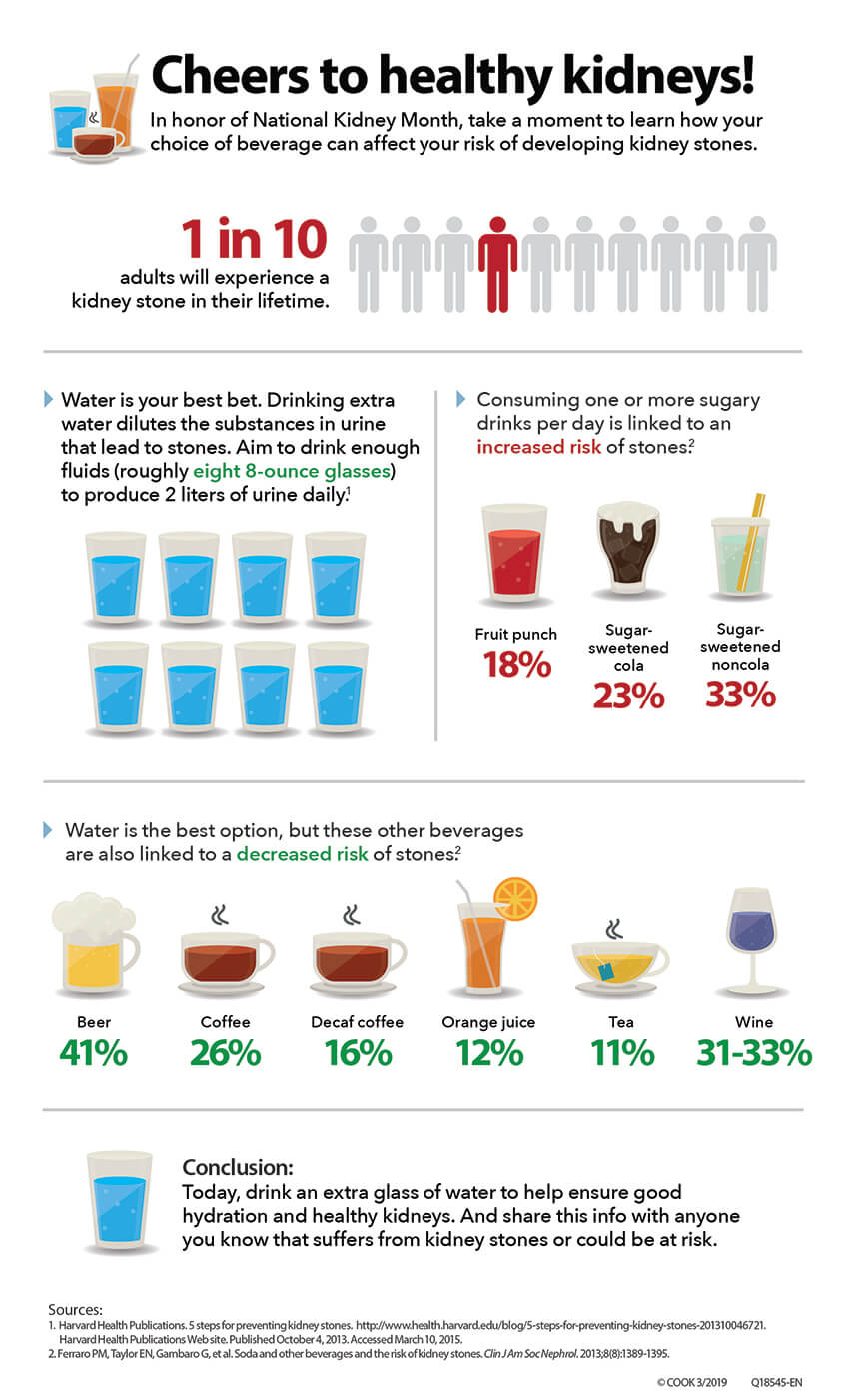
Hydration is one way to help prevent kidney stones. Check out our infographic to learn about the beverages that can keep you hydrated and help prevent kidney stones.
Did you know?
In 1998, Cook Medical introduced the NCircle® Nitinol Tipless Stone Extractor. Along with the distinction of being the first tipless stone extractor, the NCircle was the first basket to feature nitinol wire construction.9 Today, we offer 26 nitinol stone extractor configurations.
—
- Kidney stones. National Kidney Foundation Web site. https://www.kidney.org/atoz/content/kidneystones. Accessed March 6, 2019.
- Scales CD Jr, Smith AC, Hanley JM, et al. Prevalence of kidney stones in the United States. Eur Urol. 2012;62(1):160–165.
- Han H, Segal AM, Seifter JL, et al. Nutritional management of kidney stones (nephrolithiasis). Clin Nutr Res. 2015;4(3):137–152.
- The consumer’s handbook of urological health: what is a kidney stone and what happens if I get one? Canadian Urological Association Web site. https://www.cua.org/themes/web/assets/files/pdf/consumers_handbook/27-what_is_a_kidney_stone_and_what_happens_if_i_get_one.pdf. Accessed March 6, 2019.
- Ordon M. The surgical management of kidney stone disease in the province of Ontario: a population based time series analysis [master’s thesis]. Institute of Health Policy, Management and Evaluation, University of Toronto. 2013.
- Health, United States, 2009: With Special Feature on Medical Technology. Hyattsville, MD: National Center for Health Statistics; 2010:27.
- Romero V, Akpinar H, Assimos DG. Kidney stones: a global picture of prevalence, incidence, and associated risk factors. Rev Urol. 2010;12(2-3):e86-e96.
- Taylor EN, Curhan GC. Fructose consumption and the risk of kidney stones. Kidney Int. 2008;73(2):207–212.
- Monga M. Ureteroscopy: Indications, instrumentation & technique. New York: Humana Press; 2013:180.
Learned something new today. Did not realize the other drinks were beneficial as well. Thanks!
Very interesting in addition to being informative. Thank you Matt Crum!