Cool and calculating
Carl Cook and the apps he has created
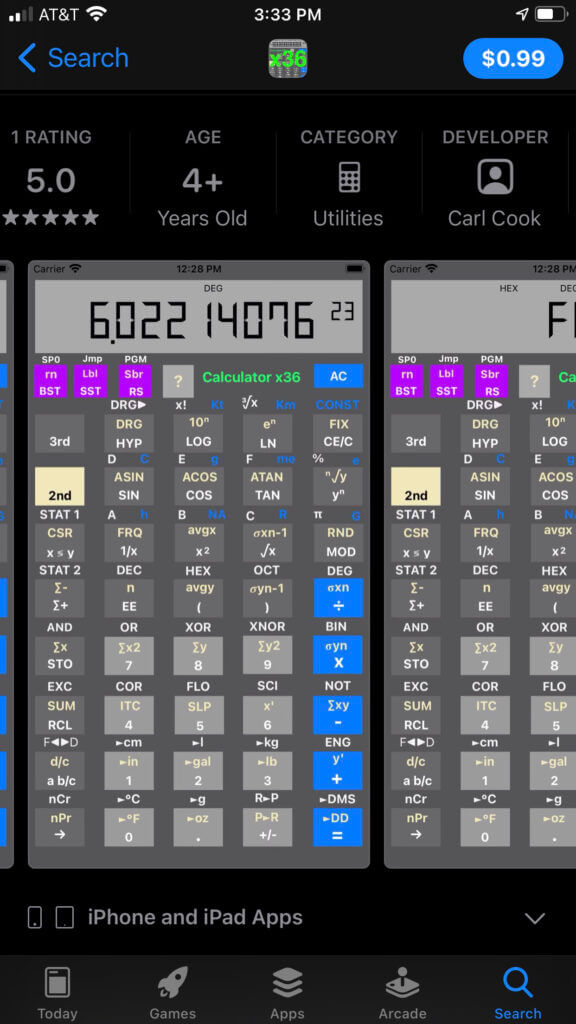
For an electrical engineer, the right calculator is the equivalent of the right wrench for a mechanic or the right guitar for a musician. It’s the tool they can rely on to get the job done—and possibly even achieve things they never thought possible.
In the late 1980s, Carl Cook, who earned an undergraduate degree in electrical engineering, found his favorite calculator, the Texas Instruments TI-36X. It’s now the one against which he measures all others.
“This is the calculator that I liked the best, especially when I was writing code for microprocessors and things,” he said. “This calculator did everything that I needed. I always liked it. It was cheap too—probably cost me $20 at Office Depot or someplace like that.”
In addition to having the right amount of functionality, the TI-36X was also user friendly, offering someone with Carl’s background a logical approach to doing problems. That combination meant that Carl was able to work effectively and efficiently on a wide variety of projects. It was even his go-to machine when he was working on pacemakers at Cook Pacemaker (now Cook Vandergrift) in the 1990s.
These days, every smart phone comes equipped with a calculator app, and the app stores are full of countless other options. One option that Carl couldn’t find, though, was a calculator app that replicated the experience he had with the TI-36X.
“They’ve changed, over the years, the way that you do the order of operations,” he said. “Like, if I want to know the square root of 35, I just punch in 35 and I hit the square root key. On the newer calculators, you have to go square root and then 35. I’ve been using those old-style calculators for so long to me everything on the new ones just seems backwards.”
That left him with no other choice—he was going to have to build his own calculator app.
Up and running
The TI-36X simulated calculator was not actually Carl’s first attempt at building an app—or at computer coding in general. He had been putting together embedded systems in C programming language since high school. Embedded systems are computer hardware systems that are driven by microprocessors and include software that is designed to perform a specific function. Examples include a digital watch—and an electronic calculator like the TI-36X. It turns out the coding language used to create apps, Objective C, is a variation of that earlier language—so it wasn’t a totally foreign tongue for Carl.
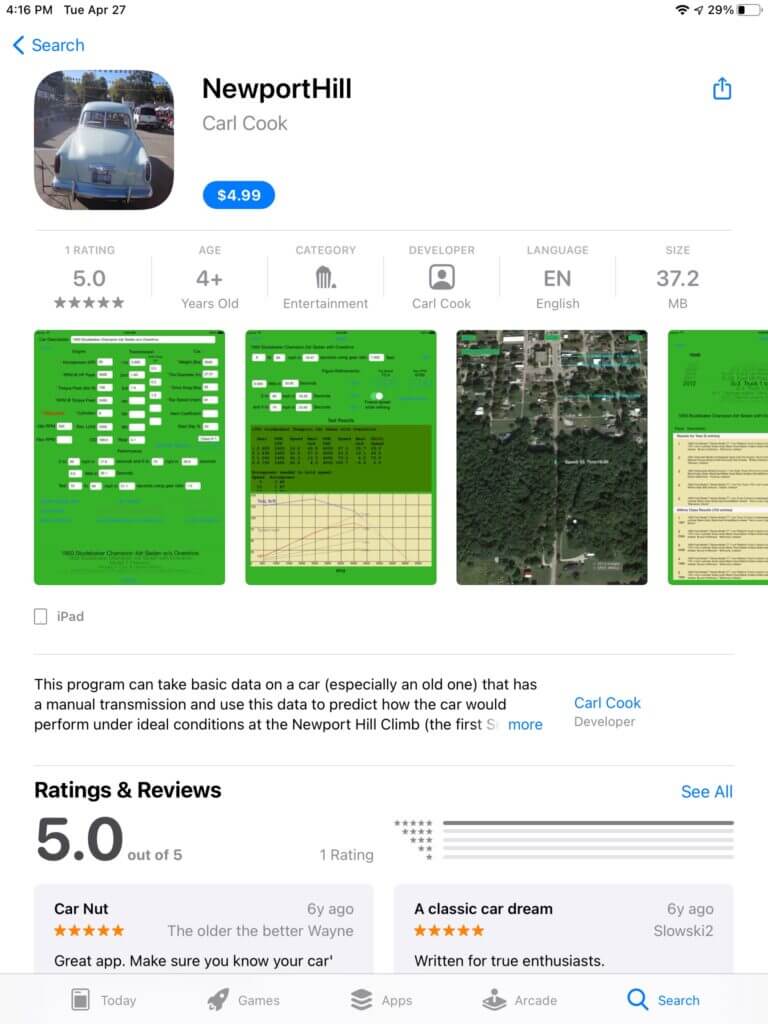
As for experience building an app, in the spring of 2014, after nine months of work, he successfully uploaded the iPad-only Newport Hill Climb app into the iTunes app store. The app was inspired by the Newport Antique Auto Hillclimb, an event held in a small town on the west-central edge of Indiana that Carl and his father, Bill Cook, competed in and that Carl continues to support today. (There’s actually a chapter about Carl and Mr. Cook’s connection to the hill climb in Bob Hammel’s book Bill Cook II: The Re-Visionary—if you don’t have a copy, send an email to Jon.Hancuff@CookMedical.com and we will get you one.) Users of the app can input information about their vehicle, do a simulated run up the hill, and then access a database of past results to see how their car stacks up against the competition.
While thousands of people attend and take part in the Newport race, only a few dozen people have purchased the app so far. All the proceeds (around $130) have gone to the event’s host, the Newport Lions Club.
“It was quite an app, but very specialized,” Carl said.
While it hasn’t proven to be a fundraising boon, building the Newport Hill Climb app was valuable in other ways.
Thanks to that app, Carl learned that the most important “hill” he needed to crest as a developer was to write enough code that you could start to run, and thus test and tweak, an app.
“But just getting it to the point where it will actually run and do anything takes a while,” he said. “You have to make sure you get the setup right at the beginning because there are some things you can’t really change back very easily afterward. Once it runs, you can play with it and experiment with it. You can add things, take things off. But getting it to that point where it will just run a little bit, so you have something to work with, is hard.”
Getting into a routine
In working on the calculator app, Carl gave himself a self-imposed deadline to hit. He wanted to have a working version ready by the time he left for a five-day transatlantic cruise in the fall of 2018. The hope was that by doing so, he could knock a couple of items off of his bucket list.
“I’d always wanted to cross the Atlantic on a ship,” Carl said. “And I finally booked a transatlantic crossing on the Disney Magic. I thought, what am I going to do for five sea days? I thought that would be a great time to write an app.”
It took about three months of off-and-on work to get the app to a runnable state before he boarded the ship. Even with that much advance prep, Carl still ended up writing the bulk of the code for the app while at sea.
He quickly settled into a routine that allowed him to not only enjoy his time on the water, but also make significant progress on the calculator.
Every day began with a workout—usually a run around the ship and then some weightlifting—followed by a quick shower. Next was a light breakfast on the deck, which kept him out of the room while housekeeping was working. Carl would then work on the app on his laptop until lunch time, when he would head to one of the snack bars on the pool deck for something to eat. Then it was back to his room for more coding, usually until his scheduled dinner at 8:30. In between meals, if he needed a break from his computer, he would walk around his cabin or watch the ocean pass by his window.
Every night at dinner, Carl was seated with the same group of passengers—including a vice president of IT for Nike.
“He understood what I was doing, and he got it,” Carl said. “He thought it was pretty cool.”
After dinner, he’d be back in his room by 10:30 and if the mood struck him, Carl would do another hour or so of coding. If not, he’d call it a day and repeat the same routine the following morning.
“I was getting at least 12 hours of coding in there,” Carl said. “But if there was a movie I wanted to see in the theater, I’d stop and I’d go watch a movie. For the most part, though, I just sat in the cabin and worked. That was a great way to pass the time.”
“How am I going to do that?”
As a trained electrical engineer, Carl was well aware of the limitations faced by the designers of the original TI-36X.
“I know how simple the circuitry is inside these things, and I know there are a lot of compromises they make in these that I don’t have to because I’ve got unlimited memory and a processor that’s not even comparable,” he said. “But when you stop and think about what this calculator does and how it behaves in certain situations and then you try to think through the logic that accomplishes that—and you start going, ‘How am I going to do that?’”
An example of something seemingly rudimentary that actually consumed a large chunk of development time (mostly before the cruise), was how to get the app to reliably display numbers correctly.
“That took a lot of tedious tweaking and trying different numbers and seeing if it would put the decimal point in the right place and if it would put the number in the right place—if it wouldn’t put zeros in front of the number,” Carl said. “And, of course, I’ve got multiple number bases. So I not only have to show decimal numbers, but I have to show them in scientific and engineering notation. I’ve binary, hex, and octo capability in here. So, I had to figure out how to do that and how to do logical operations—that was just super tedious.”
The flipside is that something he anticipated being a challenge—having the calculator follow the correct order of operations for solving math problems, which also requires a recognition of parentheses—ended up taking very little work.
In the end, Carl somehow figured out the right formula for this on his first try. It was his “aha moment” for the project.
“I was shocked that what I conceived of as an attempt to see if I was even close—just worked,” he said. “I kept trying all different ways of breaking it and it just worked.
“I have an admiration for the people who designed the original calculator,” Carl added, “because, like I said, they are working with a really, really minuscule capacity, they didn’t have a lot of memory to work with, the formatting, they had to do all of that kind of the hard way.”
“…it was just perfect for me”
When Carl disembarked from the ship in North America, he pretty much had a usable app. But before he could upload it to the app store, he still had some hoops he needed to jump through.
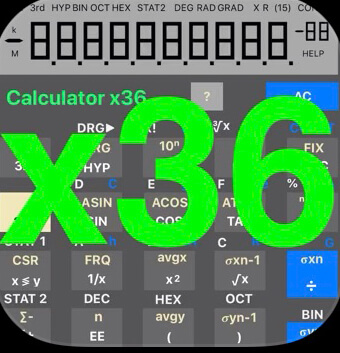
“The second hardest thing to do is uploading the app to Apple for the first time,” Carl said. “There’s a ton of stuff you have to do. You have to meet all of these specifications, you have to create an icon, you have to have a reference website—there’s paperwork.”
Initially the icon he designed was rejected, but much to his relief, he was able to convince them via email that it was acceptable.
“I don’t have a lot of ability to design anything, so I was taking pictures of things and compressing them and playing around with them,” Carl said. “The icon is supposed to look a lot like the calculator. That was the whole point.”
He had anticipated having the app in the store within a week of the cruise ending; instead, it took a couple of months. It was finally accepted on April 29, 2019. He continues to refine it, having made an update as recently as the end of April 2021. So far, around 75 people have downloaded the app. Many of those who have done so, he suspects, are friends of his wife Marcy, who posted about it on social media.
In the end, for Carl, coding and building apps is a productive and mentally stimulating way for him to fill his free time.
“It’s something I do when I’m in the mood,” he explained. “I’m not doing anything that useful. I’ve had this calculator building up in my head, and I finally got it out of my system. I’m thinking of writing a little speedometer app that doesn’t have ads and stuff just for my own use, and I’ll put it out there for free maybe, just for fun.”
Which leads an interviewer to ask Carl what he would have done on the cruise if he hadn’t had the app to develop.
“That’s a good question,” he said. “I probably would have read a book. I might have gone to a couple more of the shows. But that’s the thing—I was so glad I had this to work on, because it was just perfect for me.”
For more stories


Inspiring story
There’s something about coding that really gets ahold of you! Maybe its the constant problem-solving and logic puzzles. Programming on the balcony of a Disney cruise sounds like a dream!
This was actually a great read as a short break from work. 🙂
Thanks and keep up the good work!
Hi Nicolai! Thanks for reading the blog–and thanks for the positive feedback!
As a guy who studied Physics and Math in the 80s and 90s, I agree you can’t beat those old TI calculators, so I need to check that app out.
Great story. Coincidentally, on a Greek Isles cruise with Kathy, I took my HP 200LX and Kernighan Ritchie’s book on C–intending to learn the language. Unfortunately, I made considerably less progress than Carl!