Electronic Work Orders – Efficiency at work
A total of 2,000 electronic workstations have been installed in all production departments in Park 48 and in the Spencer and Canton facilities. The next step in this project was to roll out the EWO (electronic work order) system in a controlled step-by-step process. So, on February 20 in Park 48, about one third of the assemblers making drainage catheters began using the new system.
First day reactions
For Paula Maddox, qualified trainer, this was a long-awaited day. She was ready. Months of preparation, demo computer training, and several hours of intense training the week before the rollout prepared her for this moment. She was pumped and ready to help. Paula knew some would be afraid of the change or intimidated by the technology. “The first day went really well,” she remembered. “It was slightly hectic, but the new technology allows you to scan products, not search through paperwork to find order numbers. This creates an ease and quickness in the production line that wasn’t there before.” What was hectic, she added, was helping employees learn how to work the system and overcome the quirks, figuring the ins and outs, and recognizing that training was needed on different levels. “Some people have never worked on a computer, others know the basics, and then some are computer savvy,” she explained.
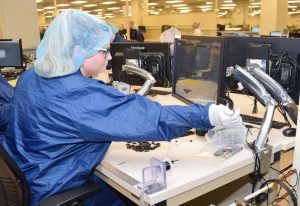
“The first day of the rollout was like training day,” said Noah Lynch, assembler. “It was a learning process for everyone. It was a brand-new system, and kinks needed to be worked out. But now it’s 90% better, and things are running so much better than we had before.” Noah smiled when recalling a couple of “Aha!” moments of discovery as he learned the new system and keyboard that day. “I remember the exact moment when I found two different keyboard shortcuts that saved my life. Someone told me about a key that refreshes the screen automatically, so I didn’t need to waste time scrolling to the top of the screen to hit the refresh button.” Then Noah described a discovery about the keyboard he found on his own that he proudly calls the “Noah Lynch special.” He discovered a key that brings the cursor directly to the top of the work order. “That’s handy in entering lot numbers,” he said.
Then and now
Noah explained that before the EWO system, paper documentation was passed along the assembly line at each stage of production. Everyone had to pull out a pen and mark the quantity and sign it. Now each production step is electronically documented through the employee entering their assigned pin number in the EWO system.
Simplicity and ease of use seem to be the buzzwords for those employees using the new EWO system. Tyler Flynn, assembler, found the transition easy because of the help from fellow employees and trainers and because of his prior computer experience. “If I had a question, it was answered directly,” he said. “The process is easier to follow now, and there are no longer handwriting mistakes and legibility issues.”
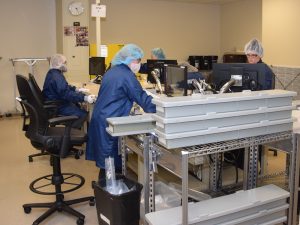
How the employees worked together was also influenced by EWOs. Before implementation, employees worked individually along the assembly line. “Now I work on a team with four others,” said Jamie Meadows, assembler. “EWOs and computers are the tools we use, but really how the team uses the system makes the difference. One of the benefits of using the system is that it keeps all information about the order in front of you on screen, which keeps your desk free from the clutter of documents. That tends to speed the production process up a bit.”
“The assembly work now is so much more about teamwork,” said Noah. “We take our work seriously, but we are all friends.”
How will EWOs improve manufacturing and help employees?
Bethany Walker, digital product manager in the IT department, stated the development of the EWO process has been an ongoing, multi-team effort. “This is a vast undertaking with input from almost every function of the facility. We are working with teams from Engineering and Quality to Operations,” she said. “Operations has played a crucial role. We are giving them the tools to make the changes, but they are making the big changes.”
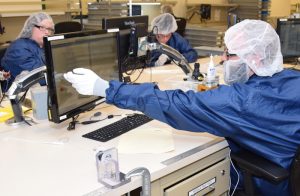
The following production efficiencies are expected as a result of the new EWO system:
Closing compliance gaps
Data is at our fingertips with the new EWO system. Any time we have an audit, the use of EWOs can help us demonstrate compliance with regulations and quickly access information.
Eliminating GDP (Good Documentation Practices) errors
“In the past, we were using a paper-based documentation process, which lends itself to errors in transposing information, legibility, etc.,” explained Dave Volz, vice president, Manufacturing Operations. “The EWO system eliminates the need for paper documentation, improves accuracy, and allows electronic scanning and tracking.”
Employees scan a barcode to bring up the work order in electronic form. In the future, all components for an order will be barcoded and will be scanned and assigned to a work order.
Providing user efficiencies
The EWO system makes documenting the production process faster and easier by streamlining documentation and steps. Previously, all of this documentation was not only recorded on paper, it was also keyed into the electronic system at the end of the process. “Basically,” said Dave, “the information was recorded twice in our current system. The new EWO system with its electronic sign-off capability as each step is performed eliminates the need for this repetitive documentation. This is one of the big benefits of going to an electronic system. It’s much more efficient to record data into the electronic system as it is happening,” explained Dave.
Currently, when a product is being built and reaches each new step in the production process, an employee must review that all other previous steps have been completed and documented correctly. Going forward, when an RPN (reference part number) is entered into the EWO system, this manual review is no longer necessary, as the system will only permit the next step to occur when the current step data is complete.
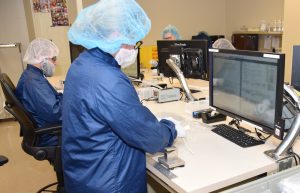
Providing real-time data
Since the EWO system allows us to track a product as it’s being built, we will now have access to immediate reports. We won’t have to wait for data like we do currently.
The complete phase one rollout for products going into the electronic system should be finished by or near the end of 2018. It is an extensive process in which all part numbers and products must be added to the electronic system.
“It’s a huge step for us to move away from paper-based documentation to electronic. It will help us on every level of efficiency as well as compliance,” stated Dave.
Amazing and Awesome!
There’s a way to do it better – Transformation & Technology…
Thank you for sharing with US!
This project is so important for our future. It will make the system more compliant and efficient for sure. But it will also enable us to do so much more as we move forward. For example when a change is made to a process our team will be able to conduct training almost instantaneously right at their work station. Thanks to all involved for pushing this project along.
Enjoy learning about all the new efficiencies Cook is investing in during this transformation!
This is incredible, Cook is always at the forefront of technology! Thank you for sharing this with all of us, enjoy the new system!