Engaging with Science, Technology, Engineering, and Mathematics at Brown County Junior High
Fidget spinners are so last year.
That meant that I needed to come up with a new activity for the 2018 career day at Brown County Junior High School in Nashville, Indiana, 15 miles east of Bloomington. Each month, the Career Resource Center of Brown County partners with the school to focus on a field of interest for all the students, with community partners giving presentations to the eighth graders. The faculty and staff know that it’s not too soon to start thinking about what the kids want to be when they grow up. Engineering kicks off the year, in keeping with the school’s focus on STEM education and the recent award of a STEM Certification from the Indiana Department of Education.
Brainstorming activities
Engagement is critical to all types of learning, and students at this age can be particularly bright and curious. As with last year’s presentation, I wanted something the kids could do themselves that would fulfill these criteria:
- Show, not tell, the skills and principles (problem solving and communication) critical to all engineering fields.
- Introduce medical devices—and Cook specifically—as a viable local career choice.
- Provide the students with a take-away they could continue to modify, either in school or at home.
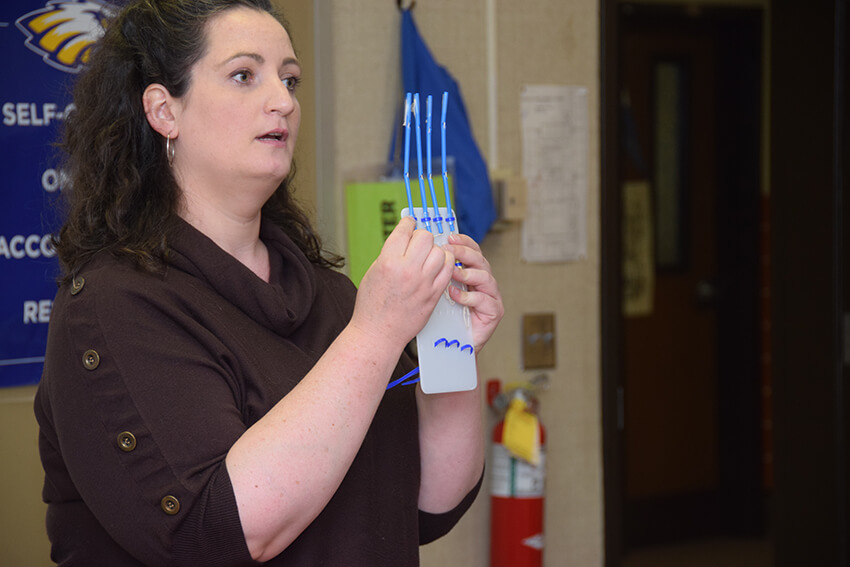
Enter the robot hand.
I can’t claim credit for the original idea. I’ve been keeping an eye out for cool projects and tossing ideas back and forth with friends. Finally, I decided I would help the kids build a robot hand— an activity which had been making the rounds of various online forums.
Designing the project
The original design for the hand calls for cardboard backing, sharp knives, drinking straws, and a lot of hot glue. If you are the parent of a pre-teen, you understand why I felt the need to modify that. I also needed the project to be one that included some medically relevant engineering materials and could be finished during each 45-minute session.
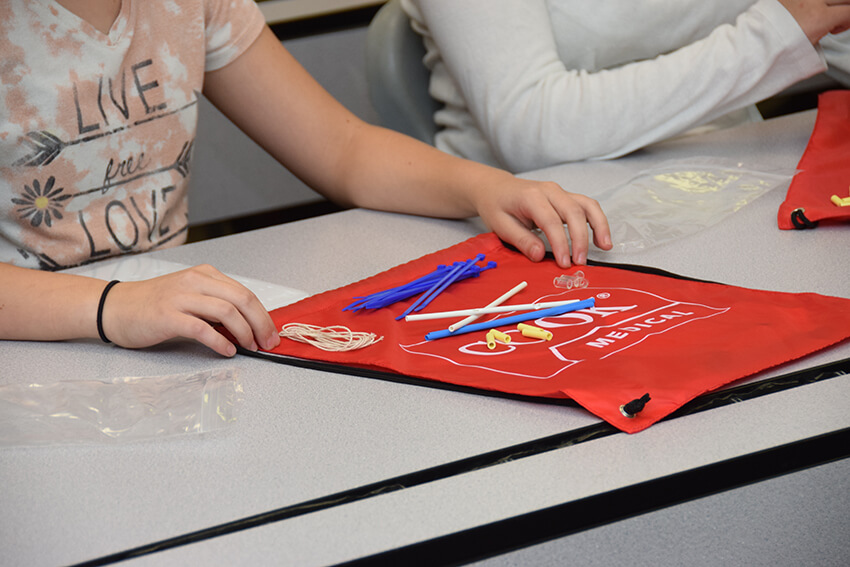
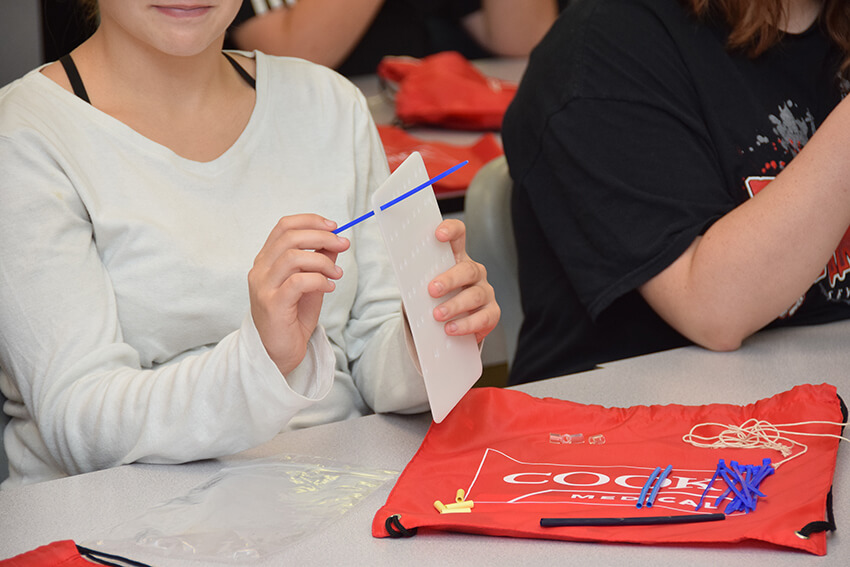
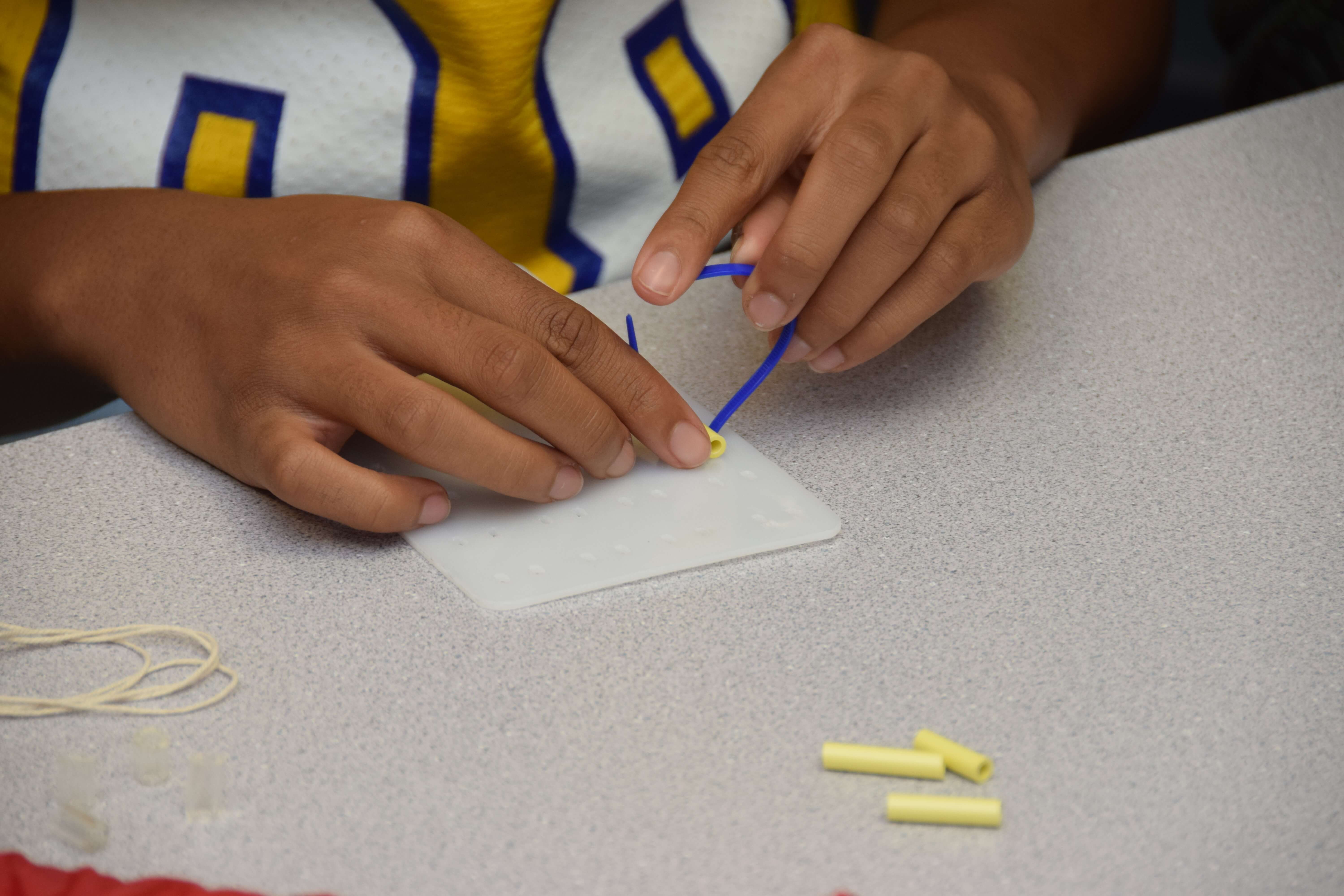
For the “fingers” of the robot hands, I used recycled tubing materials from the engineering operations lab group stash. This allowed the kids to discover the relative properties of polyurethane, nylon, and ethylene propylene. For the “tendons” of the hand, I used baker’s twine, which is cheap, easily available, and just imperfect enough that the students could brainstorm better material choices on their own. And I topped it all off with zip ties and Scotch tape—runners up to duct tape as the number one favorite prototyping material for engineers.
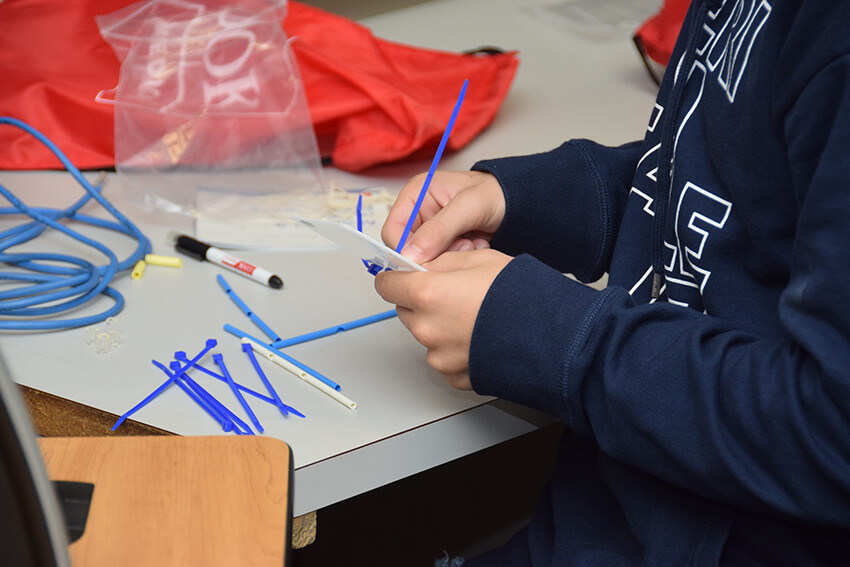
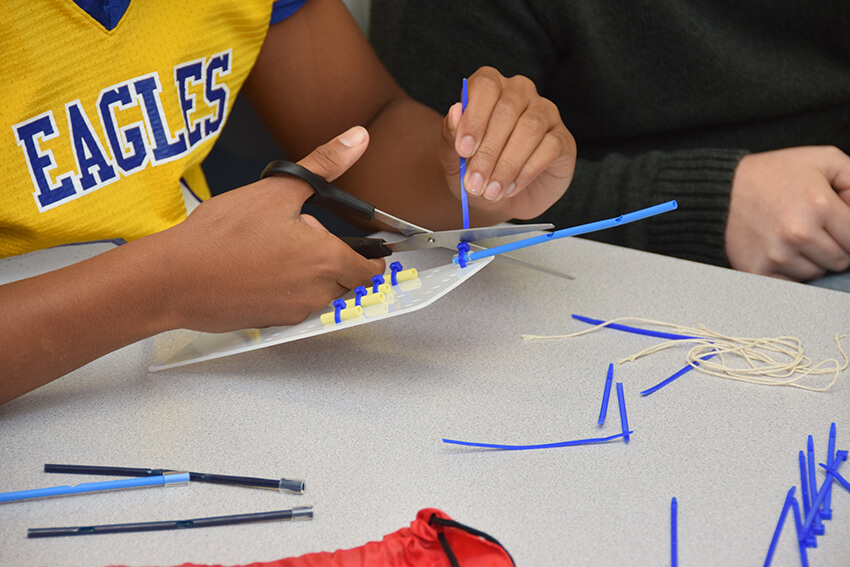
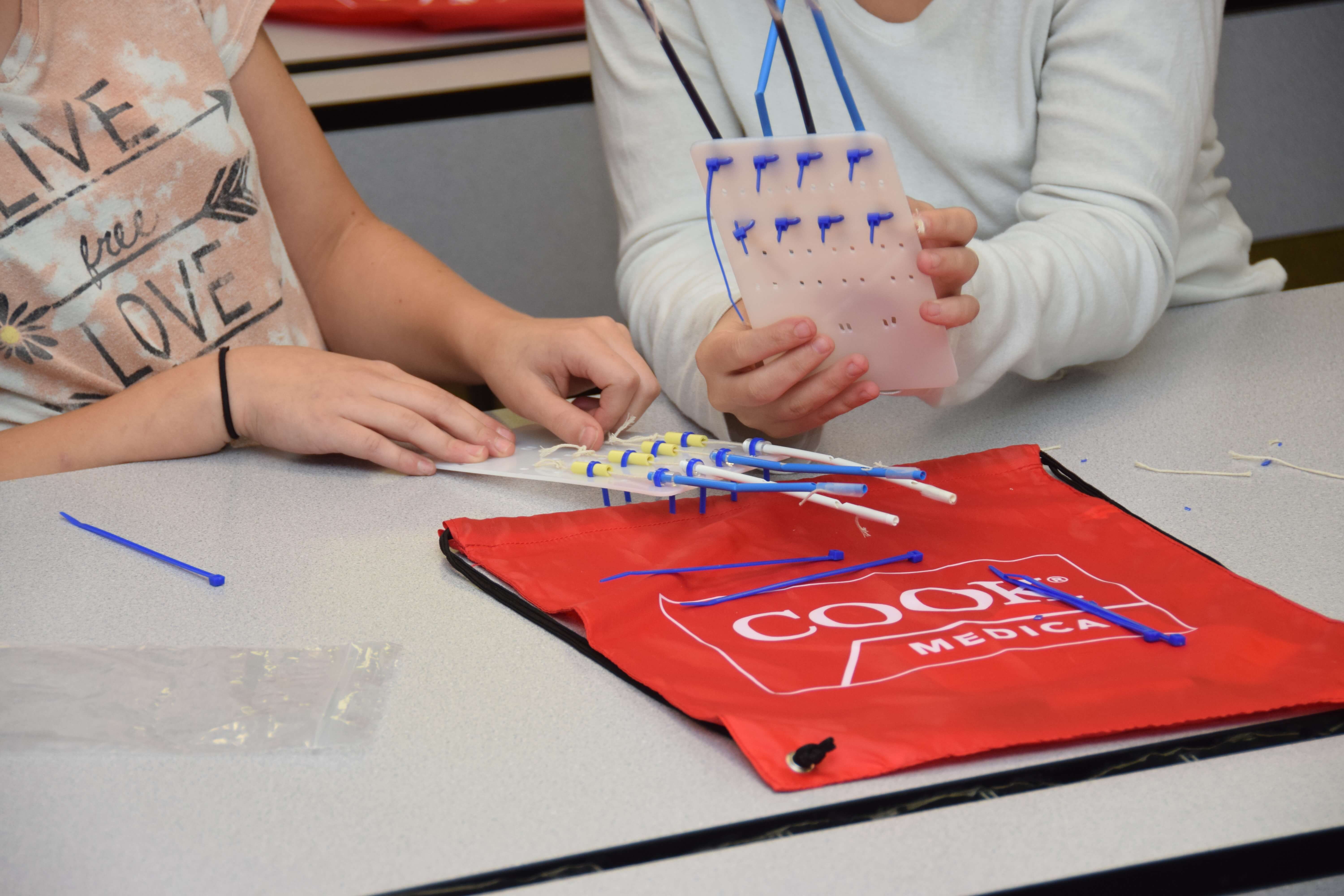
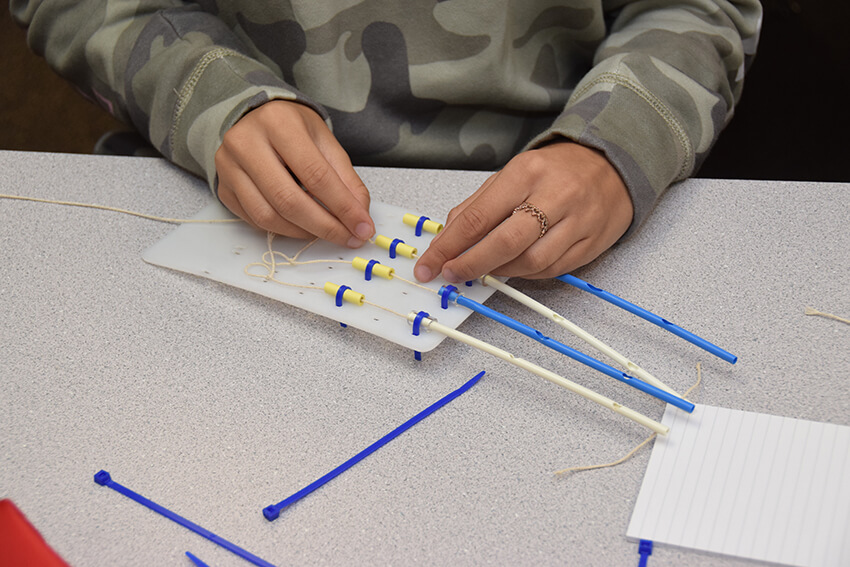
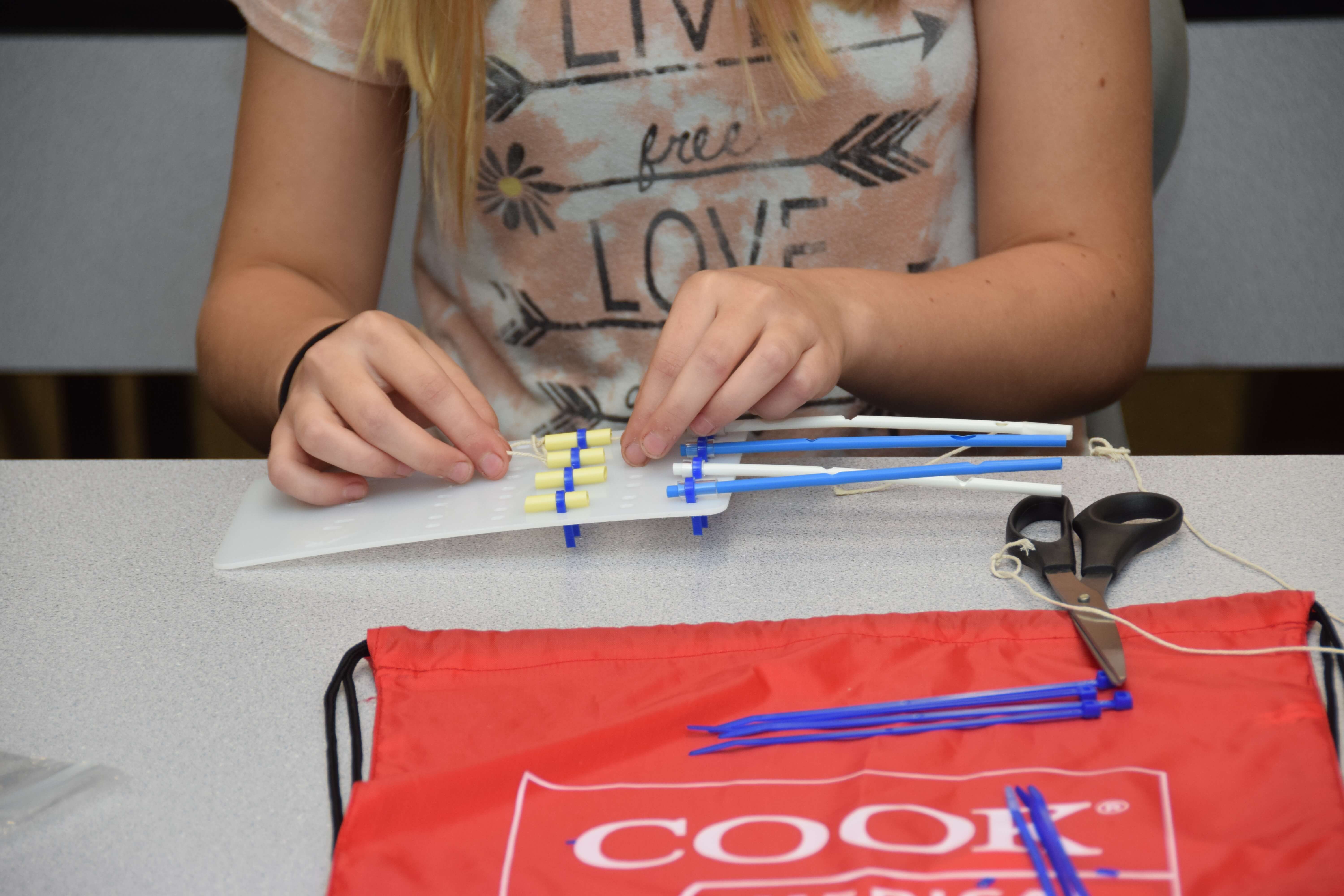
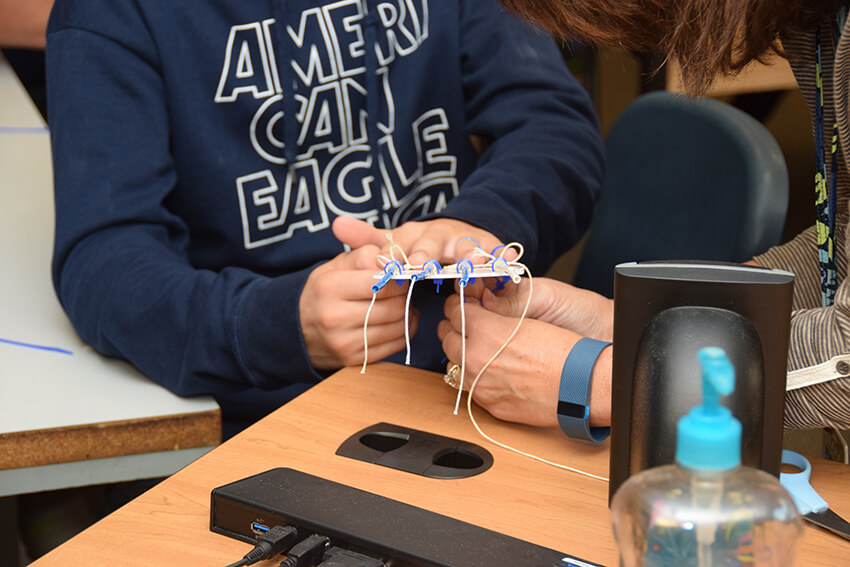
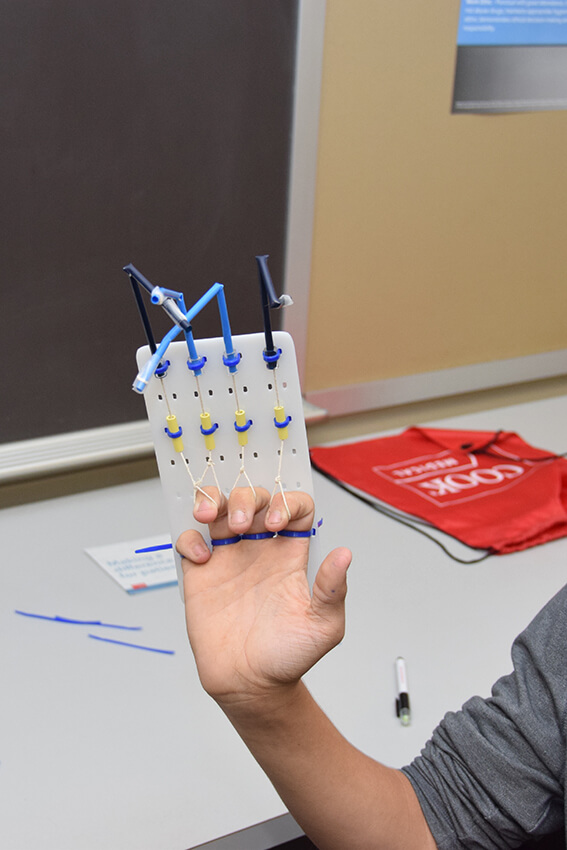
Getting everything ready
Big thanks to my Engineering colleagues Asha Kirchhoff, Becky Baumgartner, Drew Lyons, Jamie Gratzer, Cleve Koehler, Tracy Willis, and Paul Lantz, as well as Charity Chase from Human Resources, all of whom played a part in helping choose and prepare materials, and/or assemble Cook-branded swag bags for over one hundred students. I could not have made this happen without their expertise and typical Cook willingness to jump in and help.
A fun, and exhausting, afternoon
For me, it is the students who make all of Cook’s investment in this worthwhile. When I arrived at the start of the afternoon, I asked if there were some students to help lug in all my supplies from the parking lot. Two young men were sitting in the office and offered to help. I noticed one of those young men was also in the first section I taught.
There were probably close to 40 kids in that group. That’s a lot of first-time engineers learning to build a medical device. Unsurprisingly, there were a lot of learning opportunities. And yet that same young man finished early, having deduced the upcoming directions from the materials before I’d even provided them. He was one of the students who’d been in the office. Not only did he race ahead on the project, but he was able to coach others, living the “be the expert,” ideal as Brian Garman, the principal, pointed out.
In a different section, there was a young man who didn’t respond when I moved around the room to hand out kits. I noticed he didn’t interact with anyone else either (notable in a sea of gabbling 12-year-olds, who were focused on figuring out who they should sit next to). And yet when I started my spiel about the history of prosthetic hands (dating to a Roman soldier during the Second Punic War) and the mechanics of muscles and tendons interacting with bone, he suddenly raised his hand. Twice he commented on something—first to answer a question I’d posed, and second, to share a story he’d recently read about a tattoo artist who has a prosthetic hand with an on-board tattoo gun. He was engaging with the material.
At the end of the period, he disappeared with the other students, heading to his next class, and leaving behind his Cook string bag. We waited a beat, and sure enough, he came back. The principal called him by name to say hello, but he was of a single mind—he grabbed his bag and was off again without speaking. I don’t know his story, but I know this activity spoke to him.
In all the sections, the kids worked together to draw connections, help each other past sticking points, and brainstorm improvements. Groups of young men and women, in twos and threes and fives, traded tips and tricks they’d discovered, and shared extra materials. Several kids sought me out to tell me their parents work at Cook. Jackson O’Shea (son of Vascular Division’s Adrian O’Shea) was in one group and was psyched to find that the Cook brochure in his swag bag was one for which his dad had done the graphic design.
Looking back
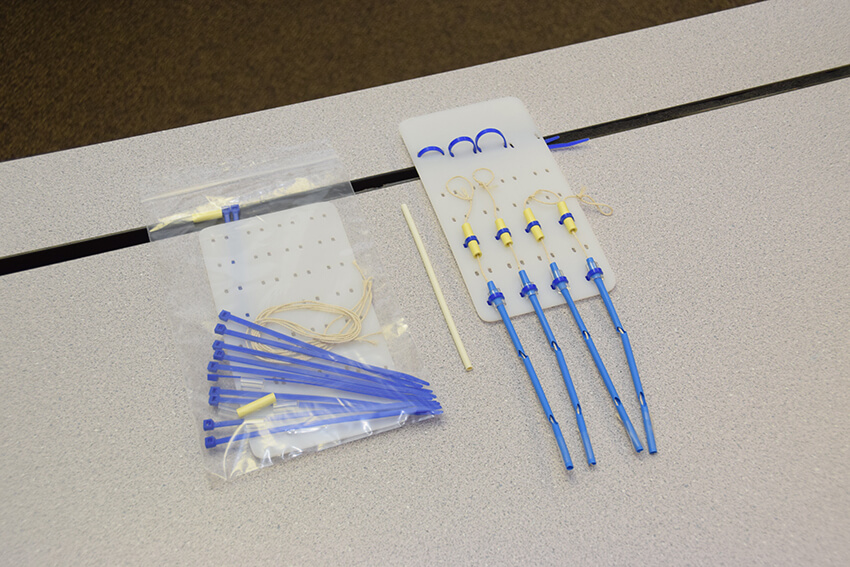
It was a fun afternoon (and exhausting… hats off to all the teachers who do this every day), but I have high hopes that the seeds sown will long outlast the specific activity. The future is coming, and tech employers have some great potential innovators just down the road. We’re not all cut out for the same paths. What’s easy for you might be hard for me, and each of us might gravitate more naturally to some careers than others. Everyone has talents, some they didn’t even know they had, and what a privilege it is to play some small part in revealing those.
The faculty, led by principal Brian Garman and with the support of superintendent Dr. Laura Hammack (wife of Anthony Hammack, the global project manager for Vascular Access), really make this partnership possible. And I owe a debt to the teachers who stuck around to listen to me repeat the same jokes through four class periods’ worth of students. Without the teachers’ and principal’s extra hands and minds, I’m not sure I could have kept up with 100 students! But they believe in these kids and in the transformative power of education and exposure. They are passionate, always open to new ideas, and flexible in accommodating my engineering projects, even if it means that for the remainder of the day there will be 100 students running around pretending to be Wolverine with their new robot claws.
Special thanks
In addition to the school faculty and the Cook folks mentioned in the main story, there are some additional people whose contributions made this event so successful. Thank you to Pete Yonkman, Nicky James, Dan Peterson, and all the other members of Cook leadership who value developing the next generation of citizens and employees, and who recognize the long-term potential in introducing local talent to Cook early. Thank you to Mark Hiatt and Chris Kabrick in Engineering for their support of this project. Thank you to Doug Wright from Corporate Communications who trekked over to Nashville to take the pictures that accompany this article. Finally, thank you to Kim Rohlfing, the global project manager for Education & Workforce within our Learning & Talent Development team at Cook, whose unwavering and manifold support of our projects with Brown County Junior High School has been so valuable.
Love the engagement! Planting seeds to grow for the future! Thanks so much, Liz.
What a great program! My son is in the STEM program at his school and has just competed in his first expo (We are in Australia)
You ‘robotic’ hand kits are so clever. you may have come up with a new range … COOK Kids STEM kits. 🙂 My son would love having a go making one.
Keep up the good work educating and encouraging out future thinkers.
Kerri, I have a couple extra kits left over, and would be happy to send one to Australia (are you at the Brisbane office?) for your son, along with some guidelines I wrote up for the teachers at the school who wanted to take this project a few steps further during the rest of the semester. I’m glad you enjoyed the post!
Thank you so much Liz. I only just recieved your message.
That is so sweet of you. He will be so excited to give it a go. I’ll keep you updated on how he goes. 🙂
Thank you for sharing. Great article for the future “History of COOK”!
Great story LIZ. What’s next?……….Can’t wait.
Great question Pam! We’ve got a cross-functional team of 11 Cook personnel about to kick off the 2nd Annual STEM Corporate Challenge with Brown County Junior High School. In October, 50+ kids will come tour the Bloomington plant, learn about real-world design challenges, products, and manufacturing safety, and get paired with Cook mentors who will help guide them as they tackle a project based on Cook products through the school year. Last year was lots of fun, and this year we have some great returning Cook participants along with some awesome new volunteers.
Fantastic work, Liz!
Thanks Liz – this is really cool!
Great work Liz – what an awesome way to inspire kids!
Such a great program…thanks for your passion, Liz!
Great article – thank you Liz for sharing your passion with students.
Thanks for sharing, Liz. Your example is inspiring!
Awesome article! Thanks to everyone involved who brought this awesome program to our community!
Awesome story! Thanks for sharing Liz.
I wish STEM days like this would have been around when I was in grade school. Even as an adult I’d have a great time with this activity! Awesome work!
Tremendous Liz!
Great story Liz! and, YOU, are the PERFECT person to interact with helping and learning with these kids!!! I’m proud that you are my team leader!!! 🙂 Great job!