FDA Vendor Day leads to better understanding
Department of Health and Human Services. The Food and Drug Administration. Office of Device Evaluation. Center for Diagnostic and Radiological Health. It all sounds very official.
That’s why I was a little surprised when I received a welcome email from them written in cheery red text and a Comic Sans font. This warm welcome still came with some very specific instructions about security procedures for accessing FDA’s main campus in Silver Spring, Maryland (just outside of Washington, D.C.), and some pointed questions about the personnel Cook would be sending to the Heart Valve/Vascular Graft Devices Vendor Day, but it set a tone that was friendly and helpful — like chatting with a colleague.
A wide range of people and questions
The people I met making their way among the vendor tables this past July ranged from Bram Zuckerman, director of FDA Division of Vascular Devices, to the teenaged daughter of Dorothy Abel, FDA scientific reviewer for Endovascular Grafts, who was tagging along to see what her mom’s job was all about.
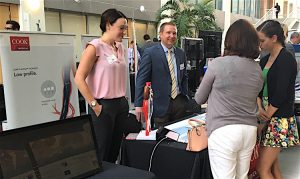
There were summer interns seeing everything on offer for the first time, and seasoned reviewers who’ve traded many an official letter with Cook, debating this or that requirement. It was a cross-section of experience, just like you’d see passing through a product demonstration station in the Cook cafeteria.
Aaron Santner, regulatory scientist for Aortic Intervention at Cook, Chelsey Ryan, global product manager for Aortic Intervention at Cook, and I came prepared with products and educational materials. Over the course of three fast hours, we shuffled visitors to the person best suited to answer their questions, and pivoted between “Is that a kidney?” (nope, it’s an aorta) and “Explain how Cook has chosen to address consideration of corrosion potential between dissimilar metals in complex grafts” (the metals are not in contact in this case).
A team approach to answering tough questions
While Chelsey fielded questions about clinical use across our product lines, Aaron maximized the opportunity to work through some highly technical regulatory questions with Valerie Merkle and Charlie Yongpravat (current FDA reviewers of Cook clinical trial submissions). Meanwhile, I spoke about the design of the products, including one of our most recent FDA approved offerings in the United States, which includes a simplified delivery system to release our tightly-packed endografts inside the patients’ vasculature.
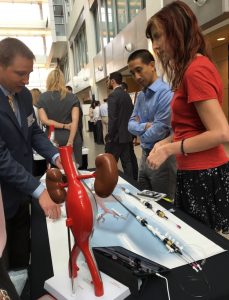
More than one visitor asked us to explain how Cook’s offerings are different from those at the neighboring tables of other vendors. This was perhaps my favorite question — answering it succinctly summarized everything we had with us, all the many years of work, and the efforts of hundreds of talented people across the globe in just a couple sentences:
Cook’s goal for aortic devices is to fit the device to the specific patient (not the patient to the device) and to make sure we create durable repairs that will best serve our customers. With our current and future offerings, we want to make it possible to do it right the first time, minimizing the risks and costs of treatment and reintervention while maximizing quality of life.
Coming away with a new perspective
A couple of weeks after the event, we received this thank you note from FDA: “We truly appreciate the efforts that you took to give an interesting presentation and to provide the necessary equipment to demonstrate the safety and effectiveness of medical devices firsthand… Please convey our appreciation to all at your company who made this visit possible.”
When I first started as an engineer at Cook over ten years ago, I envisioned FDA as a bit like a stern headmaster. Not necessarily adversarial, but not particularly friendly either. We sent them reams and reams (and reams) of paper proving the safety and efficacy of our devices, and they handed down all-knowing pronouncements.
Thanks in part to my experience with FDA Vendor Day, I’ve had the opportunity to see this relationship in a new light. FDA is just like us: a wide-ranging team of dedicated people who want to get safe and effective products to patients. And the better we understand each other, the better we can work together.
Great work Chelsey! Let’s hope this type of interaction brings better awareness at the FDA of what Cook AI is about, and that our goals are in line with the FDA’s.
Thanks for sharing…it’s nice to hear stories that make the “wall” between Cook and the FDA feel more like a “fence”. These anecdotes are really helpful to change perspectives.
Thanks for sharing Liz.
Fasinating interaction, thank you for sharing it with us!
Thanks for sharing your experience and insight!
Great to hear your perspective on this event and thank you for sharing your insight!
What a great report! Thanks for sharing this with us, Liz.
Tom
What fantastic communication, Liz! I am thankful for mission-minded folks like you in the forefront of our operation, and thank you for sharing with us. Again, great stuff!
Thanks to all for a great team work!
Thanks for sharing Liz!
Great article Liz. Thank you for sharing.
Thank you for sharing insights. Great story!
Nice Post/Article, thanks for sharing!
Great job, everyone. Great post!
Thank you, Liz, Aaron and Chelsey, for representing us well. Nice work!
Liz, This is great, and is always so good to see how you are continually trying to improve our products.
I have always thought that for a company to do well globally, management, labor and government must work as a team. All three entities bring important contributions for success. What makes it all work is good communication and sharing the same ultimate goals. This is a great example of building part of that team. Thank you for your efforts.
Great post Liz!