From normal interaction to an emergency situation

Most sales reps for Cook will tell you that our role is unique. Our reps’ role is special because of the impact we have on patient care and on healthcare providers being able to do their job better. In Critical Care, we rarely get to see our products used on patients. Most of our products don’t get scheduled on an operating room board. Instead, they get opened and used under stress– during an emergency and when a patient is in the most distress.
One example of this is when a patient has a pneumothorax, meaning that there is air accumulating in their chest cavity, which causes a lung to collapse, and so the air must be drained to allow the re-expansion of the lung. Many physicians have been trained on placing chest tubes the conventional, surgical way: making a deep incision, spreading apart the small space between the ribs with forceps to dissect through the tissue, swiping their own finger inside the incision to further separate any adhesions, and then finishing the procedure by inserting a large chest tube.1
In order to provide a less invasive method for draining a pneumothorax, Cook offers the Wayne Pneumothorax Catheter, which can be inserted using either the minimally invasive Seldinger or Trocar techniques. The Wayne Pneumothorax Catheter is a small-bore pigtail catheter, a type of small diameter catheter which has been found to have comparable efficacy to large diameter chest tubes in patients with pneumothorax.
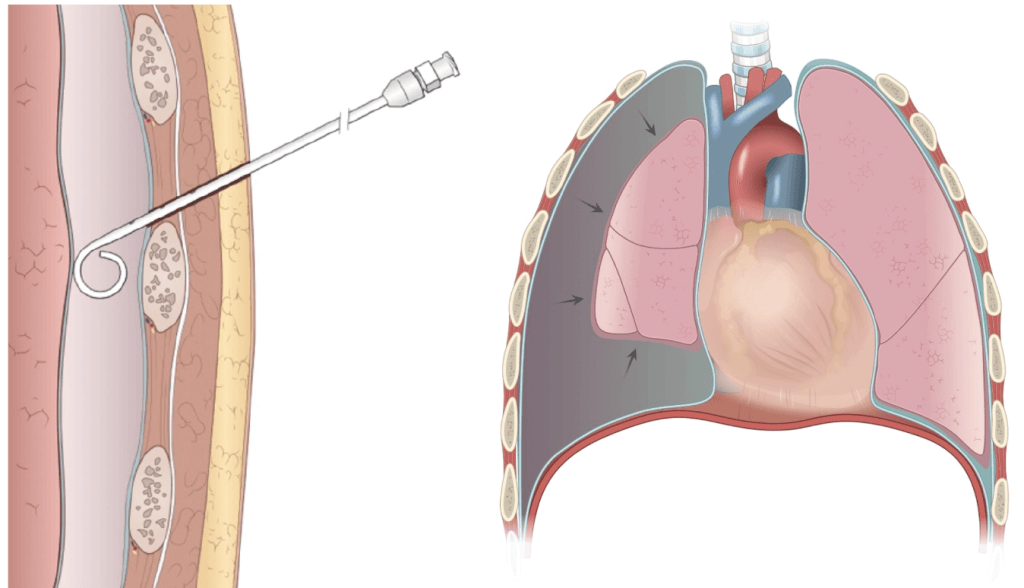
From normal to emergent
When we do get to see how a product works in a real-world scenario, it is often dramatic. This was the exact case for me when a hospital in eastern Alabama wanted to look at our Wayne Pneumothorax Catheter earlier this year, and the situation switched from a normal interaction to an emergency situation.
You can watch the video below to hear my take on this day.
After everything that happened, and with everyone feeling so grateful and relieved that everything went so well for the patient, I was invited into the hospital’s purchasing department to review a number of their products. Thanks to our life-saving, quality product, and a bit of our quality Cook customer service, new doors were opened for us to do even more business with this hospital.
Even after all this time, just thinking about that day still gives me goosebumps.
Citations
1. Pneumothorax. Mayo Clinic Web site. https://www.mayoclinic.org/diseases-conditions/pneumothorax/ symptoms-causes/syc-20350367. Accessed January 24, 2020.
—
Written by Jason Mullis, District manager, Critical Care
—
In case you missed it!
Check out the images below to see what other things are going on at Cook!


Really enjoyed listening to your story, Jason. Thank you!
Great work, Jason! Thanks for sharing your story, and thanks for always putting the patient first!
Great job Jason! What a great heartfelt story from a great story teller!
Nice to see your story, Jason! Keep up the great work!
Agree, with all the above comments.. Great story, great outcome Jason. Thank you for sharing!
Thank you for articulating this so well Jason – it’s what we do in Critical Care and it’s not always so easy to share the impact of a knowledgable and confident sales person, with a quality product and a real clinical situation. Well done you!
What e beautiful story! Thank you for telling us!
Brilliant story Jason, thanks for sharing
Great story Jason! Thank you for sharing!
Brilliant story. Thanks for sharing.
Jason, your story is wonderful and Critical Care is close to my heart, always caring and helping. Thank you for representing Cook and caring for this lady.
Thanks so much for sharing Jason. I love hearing these stories!
Great story! Thank you for sharing with us Jason. Great reminder of what we do!
Great story Jason! We still miss you in HR, but it sounds like you are making a great impact in the field. Keep it up! 🙂
Another great story of Cook folks putting our patients first. Thank you, Jason, for making all of us look good.
Nice work Jason, great example of why Cook is so well thought of in the medical industry.
Awsome! Love Cook Medical!!
Nice work Jason!!!!
Thank you for sharing your story, Jason!
Thank you Jason! What a amazing story!!!
Great story Jason I appreciate you sharing it, especially for our staff who are distant from the patient and are not able to experience the difference we make first hand.
Kudos to Jason, Sales Ops and the entire Cook Team that helps patients every day!
Thank you Jason. It’s always great to hear these success stories and be reminded of how important our job is to the patient.
Thanks for sharing Jason!
Nice job Jason!
What a great story! Thanks for sharing, Jason!
What an amazing story !!!
Nice, Jason! I will promote this on SalesForce!
Roxanne
Thanks Jason. Great reminder that what we do every day impacts patients’ lives.