Hidden gem of history: the Cook Archive
At the back of building D at Cook Medical’s Park 48 facility, in between the video department and a pod of cubicles, a narrow hallway flanked by file cabinets and whiteboards takes you to a small room. It’s off the beaten path, but if you stop and look in the Cook Archive room, you will be surprised, encouraged, and maybe even inspired by more than 3,700 catalogued historical items from Cook’s start-up days to the present. The number of items added to the archive increases daily.
As you enter the room, you are immediately greeted by a life-sized, photographic cut-out of Bill Cook. In the photo, he is garbed in a stylish 1960s suit with a disarming smile and a sparkle of ingenuity in his eyes. The photo is of Mr. Cook at the RSNA (Radiologic Society of North America) conference in 1963, which marks a turning point in his new medical device business, because it was there that he met Dr. Charles Dotter, now known as the “father of interventional medicine.” The photo of Mr. Cook tells a story, just like each item in the Cook Archive does. It’s a fitting welcome to the archive, a room brimming with a treasure trove of history.
The digital archive
In addition to the archive room, Cook maintains over 300,000 assets in a digital archive, which are currently being reviewed for image quality and labeled with descriptions by the Archival Materials team. The descriptions will provide information that identifies the photo subjects and enhances the searchability of the assets. Once a month, the team, which includes Jon Hancuff, manager, global editorial content; Tony Mitchell, archival specialist; Mike Galimore, archival specialist; Doug Wright, archival specialist; and Ashley McGuire, generalist, editorial content, join together for a day-long, eight-hour marathon of reviewing assets, helping with the monumental task of assigning descriptive tabs to the growing list of digital assets.
The archive room
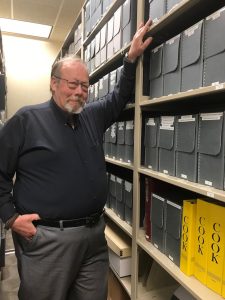
Meanwhile, back in the archive room the temperature is noticeably cool. Tony explains, “The room is purposefully temperature controlled and maintained at 65 to 68 degrees Fahrenheit to conserve paper items stored in the archive and eliminate humidity. All archived documents are also stored in specially designed boxes that protect items from ultraviolet light exposure, which can make paper yellowed and brittle over time.”
Tony catalogs each archive piece in a spreadsheet and assigns it a filing code for easy retrieval in the archive. Archive storage is divided into sections, with floor-to-ceiling shelving housed in cases, which can be opened and expanded at the spin of an attached wheel.
A formal archive
A formal archive with designated space and cataloging procedures was established around the time of Cook Medical’s 50th anniversary in 2013. As the company celebrated its past, management and employees alike began recognizing the need to preserve its historical impact on minimally invasive medicine around the world.
Cook artifacts began to be collected from across the company and sent to the archive. A Cook artifact can be found anywhere—in file cabinets, in old, dusty desks, or in not-so-empty offices. If you have a trained eye for historical value, you immediately recognize the stories behind that old photo in a desk drawer or the letter in a box of correspondence and realize that such an item can become a jewel to treasure in the Cook Archive.
The team has defined an archive-worthy artifact in its Cook archives procedure as “any item in Cook’s possession that holds substantial historical value due to its relation to Cook’s origins, organizational development, core values, or philosophy.” As part of Cook’s records management program, a Records Retention Schedule informs employees when it is acceptable to dispose of records and documents. Before disposing of any documents, we encourage you to review the archives procedure for examples of types of documents and items that should be stored in the archive rather than discarded.
The Cook Archive stores not only tangible items—reminders of Cook’s humble beginnings, successes, and setbacks—it’s also a room full of memories of the past and earnest hopes for the future. “Through your own history, you can see your successes and failures,” says Tony. “No company can afford not to learn from its successes and failures. The Cook Archive reminds us of this.”
Start seeing the value in simple artifacts that can trigger conversation about Cook, or a story or two. When you retire, for example, postcards from the past, old letters, and mementos from galas you attended are prize finds. Bring them to the Cook Archive. Contact Tony.Mitchell@CookMedical.com or Doug.Wright@CookMedical.com for more information about how to donate to the Cook Archive.
What’s in the archive?
Watch these short videos to see a few featured items.
Gianturco’s suitcase
Employee toolbox from the 1970s
The first Cook logo in movable type, from the 1960s
Hey Tony!
Great story! So glad this wonderful company’s history is being maintained. I have a few banquet pamphlets I’ve found and I’ll send them your way.
I’ll never forget our first meeting. I was checking in the returned GRII’s (coronary stents) and unwrapped one that surprised me. It was used!!!
I’m glad we got to meet no matter the circumstances and hope to see you around after our retirements…
Karen
Hi Karen, thanks so much for reading this article. I am so glad you enjoyed it. I do remember that event with the GRII. Awe those were the days!
Tony
Really enjoyed the opportunity to look back and see tangible items! I still have my calipers gifted to me in 1985 for use in complaint investigations. Note: these have been reference only for years.
Glad you enjoyed it Old Friend, I am equally glad that you said the calipers were for “reference only”
Tony
What a neat entry — and unique job to caretaker these items! Thanks for bringing it to our attention. I may have a copy of the (SBU-concocted) cocktail menu board from the Puerto Rico Sales Meeting. Maybe someone has an original. Some may also have spare Cook Medical cocktail glasses used throughout the hotel that week….
HI Yvette!
So glad you liked the article. We would love to archive any of these items you have described. After you have enjoyed them we will ensure they will be around a long time so future Cook employees can enjoy them too!
Yours in History,
Tony Mitchell
LOVED! Hopefully this is the first of many episodes of “The Cook Antique Roadshow” or “Cook! Back to the Future”. Starring our very own Tony Mitchell.. #hesAstar!
Amy You Are a NUT!
So glad you liked the presentation. Hope to do more soon.
Tony
Thanks for sharing – This is awesome!
You are most welcomed Charlotte, so glad you liked it.
Tony Mitchell
Good memories to treasure!
Thanks for the comment Abdul, glad you liked it.
Tony Mitchell
Brings back many good memories – my tool box was red!!!
Do you still have it? or at least a picture?
Tony
Very interesting and to think the things we have got rid of over the years that would have been perfect for this . Wish we had kept them all but this is really great.
Good Job guys.
Thanks so much Rita. Remember today’s junk is tomorrow’s treasure!
Tony Mitchell
Mr. Cook told me once he wanted to use that logo because it looked like the logo being used by Becton-Dickenson. He said if it looked somewhat familiar to our potential customers, they would trust us.
Cesare Gianturco used that suitcase to carry prototype devices that were too big for his suit coat pocket, typically delivery systems (catheters, sheaths, stiffeners, pushers, etc.) for occluders, stents filters, etc.. The suitcase was just a bit small for most delivery items so sometimes, when he opened the case, things literally jumped out.
I have some items with that logo and a few interesting pictures for you.
Hi Tom, Glad you like it. Great input which I will add to the items. I will check and see if you are here next week and be up to see you!
Tony
I have one of those toolboxes sitting on my desk.
If you ever want to donate it to the Archives we would be happy to have it!
Interesting to see those things ! Thanks Tony for keep it safe !!
You are most welcome. I love the artifacts here at Cook and we are always looking for new things to add to the collection.
WOW! I worked with these items. I never dreamed I’d be around when they considered them history…….but I’m glad I am. Thanks guys great videos.
Glad you liked it. If you ever want to donate anything we can always start a Pam Edwards Collection.
Love the videos.
So glad you liked them Neilly
Tony
Great job, guys! I love these quick little videos. Look forward to seeing more!
Glad you liked them Cortney, i hope to do more someday.
Tony
Great vignettes, keep them coming.
We hope to Jim
Tony
Love the videos and seeing the CI movable type 🙂
Glad you like it Tara, The movable type was my favorite too.
Tony Mitchell
love these
So happy you liked it Susie,
Tony
Not only a great article, but I just learned about the Bloomington Beagles as well! So glad Tony wore that shirt. It is wonderful that we are preserving our past while looking toward a bright future!
Glad you liked the article – GO BEAGLES!!!!
Tony Mitchell
Great Article. Thank you for sharing.
Glad you like it Mirela, you are most welcomed.
Tony Mitchell
Thanks for sharing… really enjoy seeing the Cook artifacts.
Glad you liked it Rose. There are many more we hope to showcase one day.
Tony Mitchell
Great way to expose and present our rich history!
Star performance; full speed ahead! Facing an important presentation, contact the team. Great visual / verbal communication keeps your audience from the land of Nod.
Great article, thank you!
Glad you liked it Ted, it was fun to make.
Tony Mitchell
This is really great to see peaces of history, reflect back and see the enormous changes we have gone through. In a decade or so we will look into the archives and will see how Cook Inc was before the transformation and how we changed again.
Thank you for sharing!
Glad you liked it Helen. The toolbox is a really neat story.
Tony Mitchell
These are great! And I love that green toolbox!
I love that you are doing this. Many years ago while working in the cage I saw something special close to my returns documents and thought how neat it was that these items were kept. I am so glad we are archiving them and that you are sharing. Thank you.
So glad you liked it April, they were fun to do.
Tony
Very interesting. Great job Tony! Enjoyed watching. Hope to see more.
Thanks for the kind words Sharon! So glad you liked it. I hope we can do more in the future.
Love the videos! I think that it’s a fantastic opportunity for us that we have such a rich history. I just wish that we could start using it more in our branding, customer journey/experience and marketing. As an example we recently made a time line for congresses which was very well received and I think we could use our history in a lot of other ways as well.
Only negative comment, please stop with the swaying when filming, I get that it’s probably on purpose to make it more active but to me it’s just causing nausea.
All the best from Denmark!
Anders,
So glad you appreciated the segment. I know you all have a treasure trove of historical items and hope one day you all conserve and catalogue them.
Tony MItchell
Love these segments!
Glad you liked it Julie
Tony
Fun videos to watch, thanks team for sharing these stories.
Most welcomed, glad you liked it
Tony
Thanks team, well done and fun to watch!
Glad you liked it Ron,
Tony