#InThisTogether: 13 MAY 2020
 With everything that’s going on during the COVID-19 crisis, we want to share stories about what Cook people are doing during this difficult time. All around the Cook world, we are #InThisTogether, and we would love to hear stories about how you and your coworkers are stepping up to make a difference. If you have a story to share, please email us at BlogEditor@CookMedical.com.
—
Being there for the patient, the physicians, and each other
By Jon Hancuff, manager, global Editorial Content for Corporate Marketing and Communications
Katharine Kibler was sweating. And fighting back tears.
Wearing multiple layers of personal protective equipment (PPE), including a powered air-purifying respirator (PAPR) that was pumping oxygen into her mask to protect her from contaminated air, she was in a hospital intensive care unit (ICU) in Cambridge, Massachusetts, to assist an interventional pulmonologist (IP) who was performing her first percutaneous tracheostomy, and the first at her facility, on a patient using a Cook device.
A tracheostomy is a procedure in which an opening in the neck is created so a tube can be placed into a person’s windpipe just below the vocal cords to allow air to enter the lungs. It can either be placed temporarily or permanently.
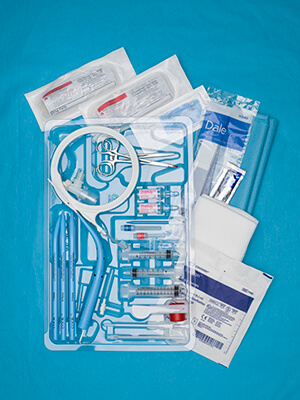
The patient was a woman who had contracted COVID-19 and had been on a ventilator for the last three weeks. The pulmonologist (a specialist in treating the respiratory system) needed to find a long-term way to oxygenate the patient and had decided to use Cook’s Ciaglia Blue Rhino® Advanced Percutaneous Tracheostomy Introducer Set.
That’s why Katharine was there. A MedSurg Critical Care rep based in nearby Boston, she had led a Vista® training session in 2019 on critical care devices, including the Blue Rhino, that the pulmonologist had attended. At the time, the doctor’s facility decided against using the device. As the pandemic worsened, though, the hospital reconsidered their position. The pulmonologist immediately contacted Katharine. This was around April 16.
“The physician reached out for some help and education so they could start planning and getting everyone else on board—all of the other key players that she would need in and around the room helping during the procedure,” Katharine said.
No specific patient had been identified at that point, but with the situation in Massachusetts quickly worsening, the doctor knew it was only a matter of time before she was going to need to use the Cook device.
That time was a little over a week later, on April 24.
By this point, Katharine had been able to do a couple of in-service (onsite) training sessions with the team using a mannequin—a model of a patient’s anatomy on which a device can be deployed. It is a common occurrence for Cook sales reps to be present while a doctor performs a procedure using one of our devices—especially when the physician has limited experience with it. Our sales reps are experts on the products they sell, so they can provide instruction and answer questions for doctors while they treat patients.
The pulmonologist asked Katharine to attend that first tracheostomy.
And that’s when the gravity of the COVID-19 pandemic hit her in way she hadn’t anticipated.
As the hospital staff were getting ready to administer pharmaceuticals to the patient, the doctor and one of the nurses took the patient’s hands in theirs and spoke to her reassuringly.
“I got choked up,” Katharine said. “It was really impactful. It was a lot. It was a heavy moment—it reminded us all why we were there.”
A new world
Like everyone else, the COVID-19 pandemic has completely turned Katharine’s life upside down. Massachusetts is one of the states that has been hardest hit by the virus. As of May 4, they had over 65,000 confirmed cases (including over a 1,000 in Katharine’s neighborhood) and almost 4,000 deaths. Anyone leaving their own property has to be wearing a mask—punishment for failing to do so ranges from a warning to a $300 fine depending on the municipality.
Katharine, who will celebrate her fourth anniversary at Cook later this year, covers a territory that includes over 80 facilities in four different states (Vermont, New Hampshire, Maine, and Massachusetts). She is used to being on the go. But now she spends most of her days on the phone for meetings. Despite the shift to a 32-hour work week implemented after the salary reduction, Katharine said that because of the increased demand for their devices created by the pandemic, Critical Care reps are working at least six days a week.
But the days when a sales rep could just walk into a hospital and meet with a doctor are over, at least for the time being.
“I think it has to be harder to get into a hospital around here than it is the Pentagon,” Katharine said. “You have to have an urgent reason for being there.”
When the pandemic first hit, and she was suddenly separated from her customers and their facilities, Katharine felt helpless. She did what she could to prepare herself—following sales and back order reports, upping her communication with product management—in anticipation of whatever was going to happen next.
When the call finally came from the pulmonologist on April 16, Katharine was ready.
“I was very excited,” she said. “I know how great our products are.”
The current recommendation for COVID-19 patients is that they shouldn’t be moved out of the ICU. So that ruled out a trip to the operating room (OR), which is where a physician would perform an “open” tracheostomy—a practice which was also being discouraged for those afflicted with COVID-19. The Blue Rhino can be used bedside, which means the physician is able to do the procedure in the ICU, where the patient was already located.
Over the course of the next week, Katharine ran some training sessions at the facility. During that time, the patient who would need the procedure was identified. The exact date the device would be deployed was still up in the air—it was either going to be Friday, April 24, or Saturday, April 25.
So, when Katharine went to bed the night of Thursday, April 23, she knew that the next day, she might be coming face-to-face with COVID-19.
Fully supported
The moment the pulmonologist asked Katharine to be present during her first use of the Blue Rhino on a patient set off a period of intense self-reflection for her. Katharine knew that by agreeing to do so, she was opening herself up to possible COVID-19 infection. She weighed the pros and cons—she doesn’t have any children and she’s not living with or caring for someone who is part of the population especially vulnerable to COVID-19 infection.
Ultimately, it was an easy decision for her to make.
“This patient really needed this and needed this now,” Katharine said. “And this physician needed to know how to do it for more of her patients. That was the priority at the end of the day.”
Still, that Thursday night, she couldn’t sleep.
She kept running through a mental checklist, reminding herself that she had already been in the hospital during the pandemic, she just needed to follow the facility’s protocol and she was going to be safe. Everything was going to be okay.
Helping set Katharine’s mind at ease was the knowledge that she had the support of the physician—and of Cook.
“The doc and I have a good rapport,” she said. “We had spoken before I went in—before even the first in-service—and she said that I only had to do what I was comfortable with.”
She had received similar guidance from Cook.
“The feedback I had gotten from Cook was that they were here to support me,” Katharine said. “They left it completely up to my discretion— I did not have to go in there if I was not comfortable. They were not going to penalize me or force me to do so. My health and safety were first and foremost.”
So, Friday, April 24, Katharine went back to the hospital to do a final in-service training in the ICU—in the same area where the patient would be treated—in the full PPE ensemble including the PAPR masks. This was in stark contrast to how she would dress to sit in on these types of procedures prior to COVID-19—just her Cook scrubs and surgical gloves.
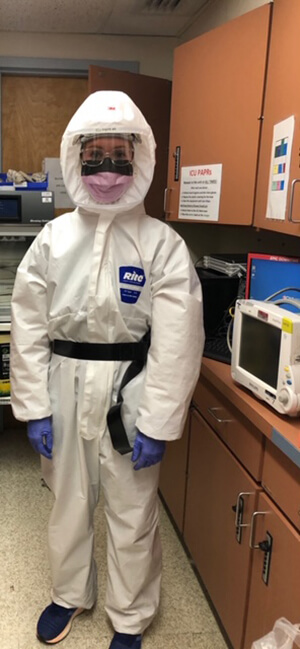
“This time I felt like the Michelin man,” Katharine said.
The masks in particular provided some unique challenges to the participants. It is much more difficult to hear other people speak while wearing one.
“You feel like you are in fishbowl,” she said. “It can be a little bit overwhelming when everyone is sort of tentative and unsure of what is going on—and no one can hear one another. So, we wanted to practice how hard it would be to speak to one another.”
As soon as the in-service was finished, the decision was made to bring in the patient and do the procedure.
Right away, it was obvious this was going to be a different experience than the previous times Katharine had assisted physicians with this procedure. With a much stricter protocol in place, everyone was noticeably more cautious in all of their actions.
“I sort of stood back and tried to make myself small,” she said. “I just asked where I was allowed to go and that is where I went.”
As noted at the beginning of this article, the multiple layers of PPE and the PAPR mask, combined with the nerves surrounding the first-time case, all while trying to stay safe under the specter of COVID-19, had Katharine sweating, literally.
“You really want it to go well, you want to make sure you have all of your ducks in a row,” she said.
Ultimately, it did go well. Katharine said she ended up doing very little during the procedure, which took around 90 minutes, just offered reminders and encouragement at a couple of different points.
“The procedure did go a little bit longer than normal,” Katharine said. “It was a slow, tentative start. But everything ended up being successful.”
By the time she left the hospital that day, Katharine had been in the PPE, including the PAPR mask, for four and a half hours.
“The first thing I did when I got out of the hospital—I waited until I got to the parking garage—I took my surgical mask off and I just stood there by myself breathing fresh air,” she said. “I probably looked like a goofball for anyone walking by. But I was just trying to breathe fresh air and decompress from being in there. It felt really intense after the fact. You are trying to be a calm force while you are in there. But once I got to leave—it was just handling everything—having all of the emotions.”
Upon returning home, Katharine undressed in the backyard, leaving everything outside, including the mannequin, over the weekend to air out. Then she showered. Later that night, the physician called to check in and to let her know that she felt great about how everything had gone.
“I slept like a baby that night,” Katharine said.
She followed up with the physician a couple of days later and was told that the patient was doing really well and that the trach looked great.
Being there for each other
Katharine came through the endeavor excited, invigorated, and grateful.
“It was an incredibly emotional experience watching these doctors and nurses work in this environment right now,” she said. “They really, really needed a helping hand. I am so grateful that I had the information and the tools to be a resource for them.”
But she is acutely aware that she is part of a bigger team—and that without the rest of that team, she wouldn’t be able to do her job at the level that her customers and their patients require.
“I’m nothing without manufacturing and without product management,” Katharine said. “I can call product management at any time of the day to find out anything I need. I know I will get fast responses and that I will have the best information.”
“And then we have these wonderful people in manufacturing—they need to know how important they are,” she continued. “I’m sure they are being told that a lot right now—and I’m sure it goes in one ear and out the other. We hear about them working these long hours and multiple shifts. We know they’re exhausted and that they would rather be spending time with their families. But we want to let them know that they are not going unrecognized. We wouldn’t be anything out here without them.”
—
Want to read more stories like this?
Click the images below to check out other Life@Cook blog posts.
Katherine,
Lots of respect to your contribution and decision. Your story once again visualize our purpose especially, in times of big challenges. We’re all here ‘in this together…!’
Thank you!
This is very great story, Katherine. Amazing!!
Great story Katharine! Thank you for the rare insight of being in the hospital and your dedication to the patients and to Cook.
Thank you for sharing your story. Indeed a powerful story, which brought tears to my eyes. Thank you for your dedicated work helping patients and saving lives.
Flawless diamonds are very rare today….and so are people like you Katherine. Thank you for being a part of the Cook team and making this great story possible .
Katharine, I really appreciated that you shared this story! While I have heard other, similar accounts from reps who were learning a new product or who were hosting an in-service, those experiences did not have the same “grace under fire” intensity that yours brought to the table. It’s very heartening to know that there are reps such as yourself who are right alongside the doctors, nurses and other hospital support staff – and that even in this time of social distancing and “stay home, stay safe,” you are able to be in the midst of a procedure, helping to save lives. Congratulations!
Awesome Katherine! Go Critical Care team!
Well done Katherine! Thanks a million for sharing this powerful story.
What a powerful story it is! thank you for sharing the story!
Very warm but powerful story! Thank you very much for sharing!
A very heartwarming story, thank you for sharing!
Great article-Thank you Katherine.
Jon-Thanks so much!
Once again-Our COOK TEAM continues to ROCK!
Thank you for sharing your story. It is so interesting to hear how things are on the front line. Must have been so confronting for you. Thank you for being their for your patients.
What a wonderful story, highlighting who we are and what we do! Katharine, thanks so much for sharing this story with all of us and giving us this added insight. We all know our devices save lives and impact families every day, but often we don’t get the opportunity to know what else goes into making it all happen. Thanks for your dedication, as well as that of all those in our Cook family who made this procedure successful!
Amazing work Katharine!!! I’m proud to be a part of the Critical Care team, working alongside you! What an unforgettable experience!
Katherine;
Thanks so much for sharing this with us! This gave me the same feeling Bill and I had when we learned from Charles Dotter and Life Magazine that the things we were making in that spare bedroom were saving lives and limbs. Everyone at Cook should have that experience and your story has made that possible for them! God bless you Katherine!
Tom O.
Well done Katharine. Very proud of you!
Such a great story. Thanks to everyone at Cook for all of their hard work and dedication.
Thank you, Katherine, for sharing this experience with us. We are all so very proud of all of our employee’s commitment and dedication to serve our ultimate customer, the patient. In the face of personal health risk, you overcame the fear and answered the call to help our fellow brothers, sisters, husbands, wives, fathers, and mothers. Thank you!!
Katherine, thank you for being on the front line and doing whatever it took to make sure that your clinicians got the support they needed.
What a great reminder of the impact Cook people have on patients that need our products. Thanks for being brave in the face of COVID, Katharine, and thanks Jon for creating the story!
Great work, Katherine! It is a great example of how impactful our products can be and what it takes to help physicians take care of their patients. Thank you for sharing the story!
Really great telling of a wonderful story. Every day, I find another reason to be proud to be a part of the Cook Medical family. Thank you, Katherine, for your dedication and for going the extra mile for your patients and HCPs.
Uplifting story – good job !
Great story! Thank you for your commitment to improving patient care.
My mother used to say that a simple but sincere thank you was all you needed to show your appreciation. So THANK YOU Cook Team and Katherine for your marvelous efforts.
What a remarkable story, thank you for sharing. Great job Katharine, we all appreciate how you went above and beyond for the patient! So proud to work for Cook and very proud of the contributions/sacrifices that all employees are making during this pandemic.
Thanks Katherine for sharing such an emotional story. And hat’s off to you, Jon, for bringing it to life so well.
What an extremely powerful story and message! Well done, Katharine! Thank you for continuing to put the patient first during these challenging times.
Making a difference. You certainly did! Another story of the reality of COVID and how health care people deal with it. Sometimes when I have my mask on and my glasses fog up and I feel breathing is uncomfortable I envision those health care people and their discomfort and decide I have so little to deal with in comparison. Proud of our devices that help save lives and the production team that make such great products.
Katharine & Cook family – Thank you all for sharing this story. I live in East Tennessee and our exposure to COVID-19 has thankfully been extremely mild but the anxiety/fear for the hospital staff is very real. I cannot imagine the thoughts that must have went through Katharine’s mind as she prepared herself for this exposure. I am very thankful there are people like Katharine out there willing to help even when it is scary. I come from a clinical background and from time to time the hospital would label a political figure or athlete a VIP at the institution I used to work at. This would infuriate the physicians because they deem every patient a VIP. A physician once told me every patient is important to someone, loved by someone, and mourned by someone. Thank you Katharine, for realizing this patient’s importance, helping them receive life-saving care, and functioning in the privileged patient support roll with an amazing amount of integrity.
Proud to be a Cook employee! God Bless all of our reps and manufacturing personnel!
Heart warming story, thank-you for sharing it. The impact that Cook has is so important, and each person’s part in making the difference’s in our patient’s life is uplighting, it really brings home the fact that this is not just an ordinary job. Thank-you Katharine, for having the faith and commitment to go to the hospital, and be a part of a life changing situation and representing the Cook family.
Katherine…you are my hero! Thanks to you and the many other Cook Medical representatives and manufacturing folks who are out fighting the good fight and being a beacon or light and hope for the rest of us.
Great write up! Thank you for sharing.
This is one of the most touching and heartwarming blogs from Cook that I have read. I can’t imagine the mix of emotions that you must have felt before, during, and after this experience. Thanks for being on the front lines of the pandemic. It makes me very proud to work for a company that does the things we do for others – especially during this very unique time we are living in.
This brought tears to my eyes. Outstanding article Jon, and so impactful Katharine. I’m sure this experience will stay with you for the rest of your life.
I’m so proud to be a part of the Cook team, because my teammates are amazing!!!!
I don’t normally get to emotionally attached to the blogs but this one really got my attention. Great story for all of us to understand just what this is all about. Inspirational to say the least.
Thank you for being there, Katharine. Great job!
It is wonderful to read the Story and I felt the same as Katharina.Great Job and thank you for sharing.It makes us proud of working by COOK,too!
Thank You Katharine for sharing this great experience and for what you do! – I know we in Production really appreciate hearing how our products help patients and save lives!
Katherine, thank you for sharing your story and showing, once again, Cook’s concern for patient and employee. I’m sure this experience will be with you for years to come. Thank you for voicing your appreciation for our manufacturing teams. #In This Together.