Investing in community
Cook’s Historic Archives and the Laconia General Store
Written by Morgan Bruns, who was a summer intern with the Editorial Content team at Park 48.
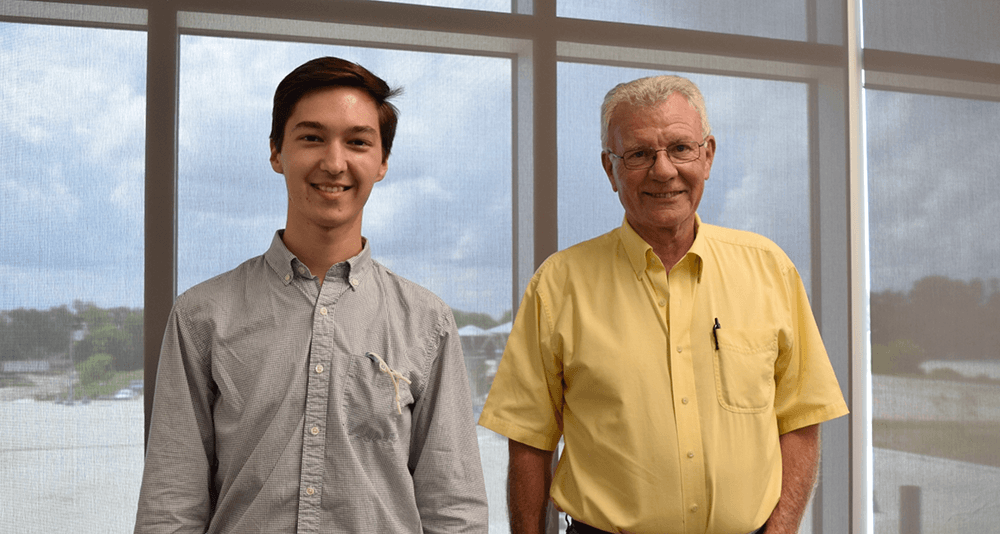
In 2018, a team consisting of Terrie Nicodemus, Tony Mitchell, and Jason Brown created a series of videos for the Life@Cook blog presenting items from the Cook Historic Archive. You can watch these videos and learn more about this project by clicking here. Inspired by these videos, Wayne Hastings and I created our own video after interviewing George Ridgway about the Laconia General Store, a historic site that was restored by Bill and Gayle Cook in the 1990s.
The Archive Room
If you haven’t been in the archive room, it’s probably because of its hidden location. It’s tucked behind a row of cubicles in the front of Building D at Park 48. However, once you do visit, you’ll be surprised to see how much of Cook’s history is packed away in the many boxes that line the shelves.
Upon entering the archive, you’ll immediately feel a drop in temperature. The room remains at 65 degrees Fahrenheit. This is necessary because heat or humidity cause paper documents and textiles to degrade more quickly. With this precaution in place, the 10,000 artifacts in the archive are well preserved. This includes photos, news articles, marketing pieces, and other items that document Cook’s history and culture. These are often used at Cook anniversaries and retirement celebrations, sales meetings, trade shows, marketing pieces, and even in the Life@Cook blog or Angiogram.
In addition to regulating the temperature, there is a strategic method of organization in the archive room. An item can only be placed in the room if it no longer serves any active business and it possesses historical value that is relevant to the Cook company. These items might chronicle the origins of Cook, depict a landmark event in Cook’s organizational history, or strongly reflect Cook’s core values, culture, strategy, or philosophy.
Once an item is deemed archival material, it is then recorded in Cook’s archival software. The archivist will enter significant details such as the name, date, description of the item, and storage location. This makes the item easily accessible if it’s needed in the future. The archive has designated locations for items based on the category they fit in, such as Cook catalogs, newsletters, and datasheets.
The archivist
The current archivist working in the archive room is Wayne Hastings. Wayne is a Bloomington native who has been interning at Cook since February. He recently graduated from Indiana University with his bachelor’s degree in arts management from the O’Neill School of Public and Environmental Affairs. Wayne has always had a strong interest in working in museums and cultural centers. This interest led him to a previous internship at the Monroe County History Center. During his time there, Wayne discovered a passion for archival work and a love for history and culture from his home state. This newly discovered passion brought him to the Cook Historic Archives.
“Working in the Archive has led to great learning experiences and opportunities to learn about how the Cook family has continually shaped life in Bloomington for decades,” he said.
The producer and author
The producer of the video and author of this blog post is me, Morgan Bruns. I am from a place commonly referred to as “The Region” in northwest Indiana. I will be a junior at Indiana University this fall where I am majoring in journalism, with a concentration in public relations, and minoring in communication and public advocacy. I interned at Cook from May to August on the Editorial Content team. I became interested in editorial content after taking a visual communications course. This is where I learned the tools and skills that I use every day here at Cook. I love being able to tell stories through different channels of media, whether it’s through videography, photography, or writing.
Why the Laconia General Store?
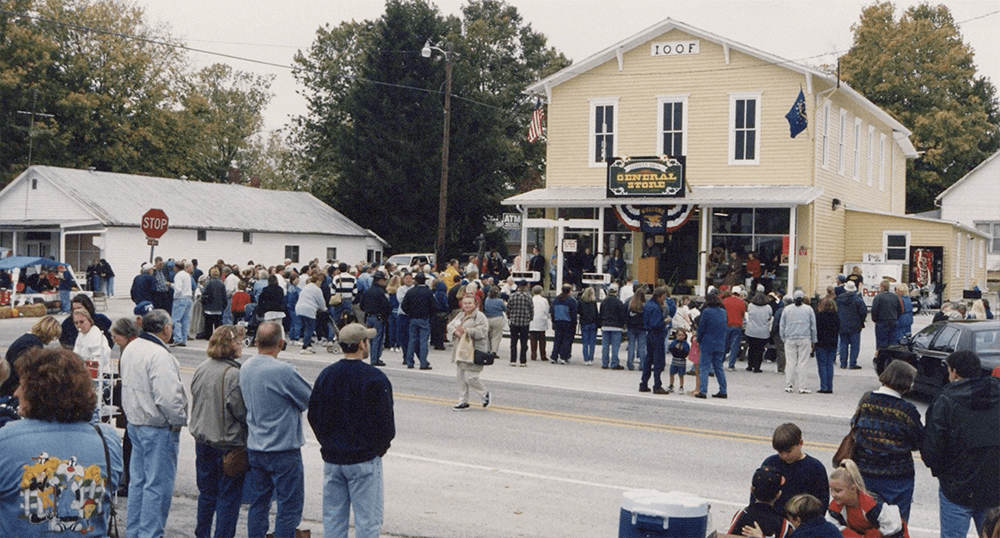
We decided to create a video around the Laconia General Store after Wayne came across a photo album from its reopening in 1999. This sparked our curiosity and we reached out to George Ridgway, Cook’s chief architect, to learn more about its restoration. We met with George at Profile Park in Bloomington, where he took us on a walk down memory lane and gave us firsthand insight on the story of this store.
As many of you know, the Cook family are avid preservationists. If we wanted to make videos on the entirety of their restoration projects, we’d have a never-ending series for you to watch. They preserved and restored many historical sites in Indiana, including the James Cochran House, The Grant Street Inn, the Yoho General Store, the French Lick Resort, Beck’s Mill, Fountain Square Mall, and Cedar Farm.
The process
Just a few years after Bill and Gayle Cook finished the restoration of Cedar Farm, they moved on to their next project, just 10 minutes north. According to George, Bill would always joke that he was in competition with Melvin Simon, the co-founder of Simon Property Group, which owns shopping malls around the country.
The Laconia General Store, founded in 1927, was in desperate need of a restoration. David Steen, a manager at their previous restoration site, was part of the Odd Fellows Lodge that occupied the second floor of the store. Bill, Gayle, and David decided that the Laconia community needed to have a general store. After purchasing the building, they proceeded in the store’s restoration with the help of George, Greg Blum, David, and others.
When it was purchased, the store was hardly functioning. There was wood rot, infestation, and typical deterioration. Fortunately, they had George, an architect, and Greg, an engineer, on their team. The two examined the building, taking measurements, creating drawings and blueprints, deciding what needed repaired, updated, fixed, and how to do it. They then explained these needs to the Pritchett Brothers, a local construction company that has worked on projects for Cook since the 1960s. They restored the building and added an HVAC system. They later installed a service station to the store with two pumps and a diesel tank. They did their best to keep the store looking traditional. This included keeping the taxidermy in the building because it reflects the towns known hunting areas.
“The restoration of Laconia was putting the building back to the way it was originally built,” George said.
Because of Bill and Gayle’s investment in this community, the Laconia General Store reopened in 1999 and still serves the town’s population of 51 people today. It is known as the place for town gatherings, where locals shop, and where regulars are on a first-name basis with the store’s employees.
Check out the video below!
For more stories
The store now has tables with historic pictures under glass, another way to see the wonderful history. They would love for any, and all, of us to come and visit. Great story on a wonderful save by Mr and Mrs Cook, and continual saving by CFC Properties, Dave Steen (and crew) as well as the Cook Family!
Great job!!! Absolutely love this store.
Nice story and interview video!