Preserving Bloomington’s embodied energy
CFC Properties paves the way for historic preservation
For the past 47 years, CFC Properties, the real estate arm of Cook Group, has paved the way as a historic preservation leader in Monroe County, Indiana, where Bloomington is located. Saving and preserving many of the community’s historic structures has been paramount to CFC’s mission. A few of CFC’s significant renovation projects in the area include the Cochran House, Graham Plaza, Fountain Square Mall, and Showers Plaza.
While preserving and renovating have many benefits, perhaps one of the more notable benefits is “embodied energy.” Embodied energy is a term that gets a fair amount of attention within the preservation and renovation movements.
Embodied energy
Embodied energy breaks down into four parts:
1. Initial embodied energy – the amount of energy used for the excavation, manufacturing, transportation of materials, and construction of a building.
2. Recurring embodied energy – consumed by refurbishing and maintaining a building during its lifecycle.
3. Operational energy – consumed by electricity, heating, cooling, and powered appliances.
4. Demolition energy – consumed by disposing of the old materials.
According to the Whole Building Design Guide from the National Institute of Building Sciences, recent advances in lifecycle analysis suggest it takes roughly 30 years for a newly built sustainable structure to recoup energy outlays when compared with a renovated building.1
Environmental benefits
It’s important to recognize how much energy has already been consumed during a building’s lifecycle because energy consumption produces CO2, which contributes to greenhouse gases. Energy embedded in an existing building can be significant. By preserving an existing structure, additional materials are diverted from being added to landfills as well.
“One of the greatest forms of recycling can be viewed as renovation for adaptive reuse,” said Jim Murphy, President of CFC Properties.
The practice of adaptive reuse consists of using an old building or site for something other than it was originally designed or intended to be used for, and is typically done with preservation efforts in mind.
Good bones
Bill Cook, who along with his wife, Gayle, founded Cook, thoroughly enjoyed visualizing a building’s potential, imagining what it could be and how it could be updated for modern-day uses. CFC has adopted a similar approach; if a structure has a solid foundation, infrastructure, and is architecturally or historically significant in some way, then it’s worth considering saving.
“Preservation keeps our nation’s history and culture alive, and we learn much from the methods and practices of those who came before us.” – National Institute of Building Sciences
Preserving downtown Bloomington’s embodied energy
What began as a passion of Bill and Gayle Cook, restoring historic and architecturally significant structures eventually sparked the revitalization of downtown Bloomington and helped preserve over a century of embodied energy.
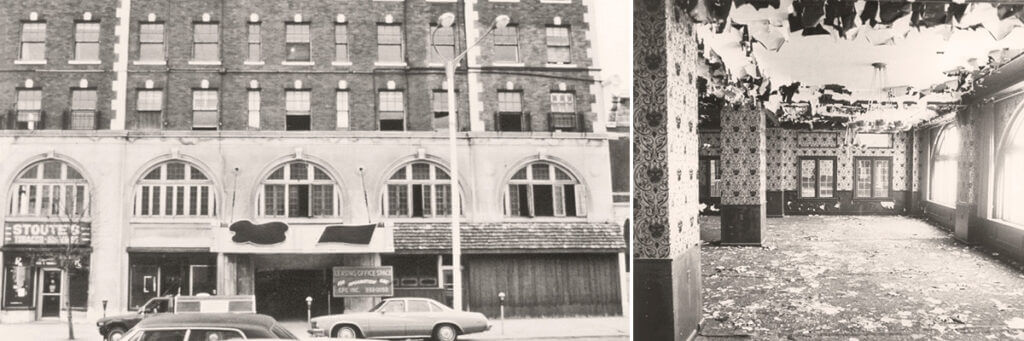
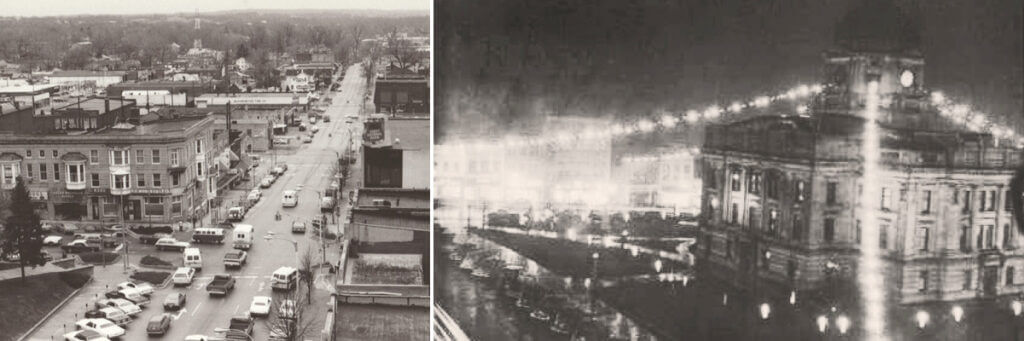
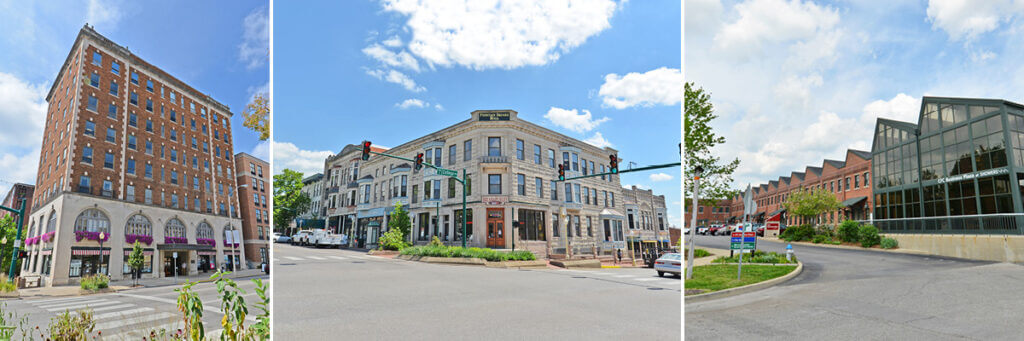
From the mid-1960s to the early 1980s, people, people, businesses, and jobs began leaving downtown area, and over time the abandoned buildings fell into disrepair. Determined to reverse the downward spiral, Bill Cook proposed to renovate Graham Plaza, an eight-story building on the downtown square. Formerly known as Graham Hotel, it was built in 1929 on the site of the old Bowles Hotel (also the former Gentry Hotel built in 1899). The hotel was considered “the glittering hub” for Bloomington’s social activity through the 1950s because it attracted Hollywood stars and notable businessmen to town. CFC completed the renovation by 1982, and today, the building provides retail and commercial space to consultants and business owners alike.
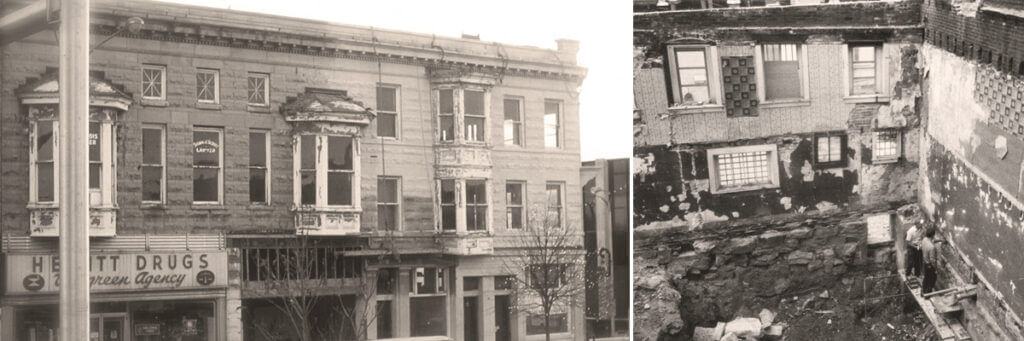
Between 1982 and 1988, CFC worked on a variety of preservation projects, but in 1988, they would undertake a prominent project in downtown Bloomington. In 1988, CFC announced they would renovate the entire south side of the downtown square. This was referred to as “The Anchor Project” because it would ultimately catapult revitalization efforts downtown. This massive undertaking began with 13 buildings, which eventually reduced to ten, then, those ten merged into one, forming what is now Fountain Square.
March 2, 1985, Bill Pittman, a journalist for Bloomington’s Herald-Times newspaper, wrote, “A $50 million partnership of government and private enterprise is nearing fruition, bringing the central city back from the graveyard.”
Fountain Square’s collection of historic buildings’ construction dates ranges from 1859–1936. According to historical records, the building at the corner of East Kirkwood Ave. and South Walnut St. is one of the oldest buildings on the downtown square.
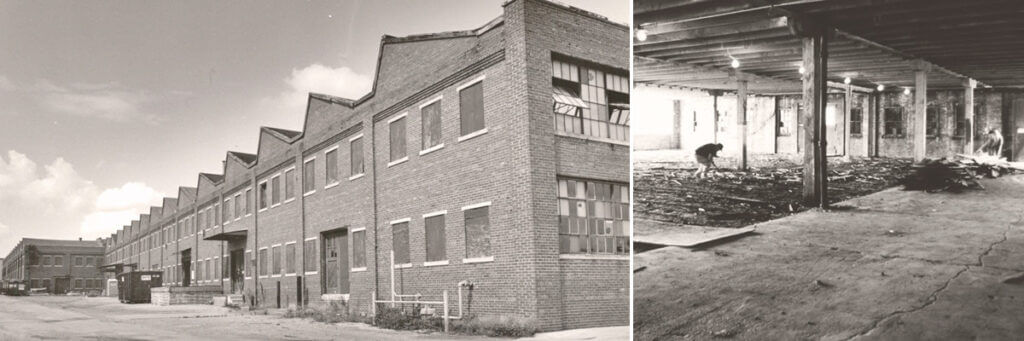
The Showers Building, located in the CFC Business Plaza, was once the home to the Showers Brothers Furniture Factory, the largest in the world by the 1920s. Prominent for its saw-tooth roof, the building has been an important Bloomington landmark for over 100 years. In 1995, a partnership was formed between CFC Properties, the City of Bloomington, and the Bloomington Advancement Corporation to renovate the 200,000 square foot space. Today, the building serves as a center of activity for CFC, the City of Bloomington, and the Monroe County government offices.
Preservation benefits
Renovation and preservation projects offer many benefits aside from making use of the existing embodied energy. The Federal Historic Preservation Tax Incentives program provides financial savings opportunities as well. It is known as one of the government’s most successful and cost-effective community revitalization programs that offers incentives for certified historic and non-historic structures.2 To learn more about these incentives, visit nps.gov/tps/tax-incentives.htm.
Get involved
Efforts to preserve the history of downtown, including its revitalization, may have started in the early 1980s, but efforts continue through CFC Properties and Downtown Bloomington Inc. (DBI), a Main Street America program. DBI is a non-profit that was started in 1984 to help continue the revitalization efforts. DBI’s mission today continues to focus on educating the public of the benefits of a strong downtown, to facilitate public and private partnerships, and to provide unified leadership to strengthen and support the heart of the city. To become a supporting member or to volunteer, please visit downtownbloomington.com.
By the numbers
Year-to-date, CFC Properties has restored 34 buildings, 21 of which are listed on the National Register of Historic Places.
The benefits of the number of restoration projects CFC has led over the past 48 years are difficult to measure; however, their impact has been profound. Thousands of community jobs were created, several iconic buildings have been saved, and the community’s history is being preserved. Through it all, these efforts have helped curate a hometown that locals are proud to talk about, including a unique historic destination for visitors.
CFC’s commitment
CFC Properties is committed to preserving the past and creating a better future by engaging and enriching the community through growth, philanthropy, equality, and education. The company strives to be a positive role model to its employees and the customers they serve.
Learn more about CFC, including its properties, by visiting cfcproperties.com.
Sources
1. Whole Building Design Guide. Sustainable Historic Preservation. Updated 08/26/2019. Retrieved from http://www.wbdg.org/resources/sustainable-historic-preservation,
accessed on 04/22/2021.
2. National Park Service U.S. Department of the Interior. Tax Incentives for Preserving Historic Properties. Retrieved from https://www.nps.gov/tps/tax-incentives.htm, accessed on 04/22/2021.
For more information

Bloomington wouldn’t be the same without CFC! Thanks for sharing!
Great article, which highlights Cook giving back to the community is not just a reaction to more recent events.
Would love to see a more in-depth story, with pictures of each renovation job
Wonderful article! The stories fill my chest with great pride to be associated with these buildings and the hundreds of businesses who occupy them. Very nice Rebecca!
Excellent article about the great work done by CFC, then and now!