Roeder’s Everesting escapade
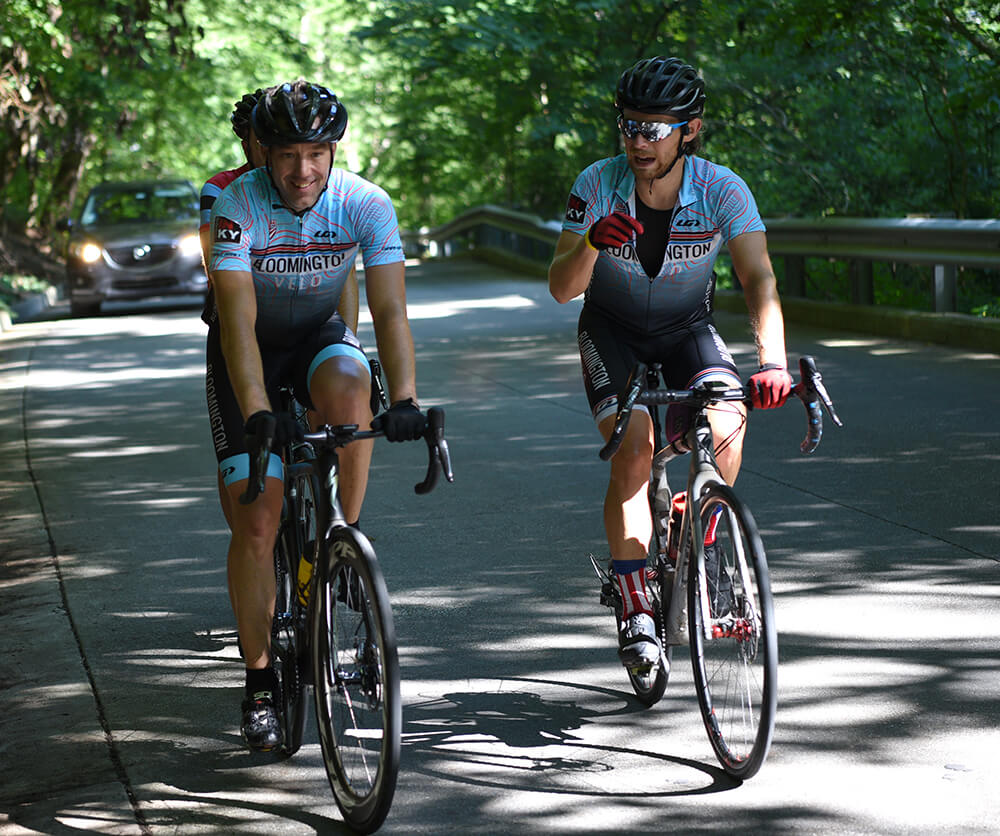
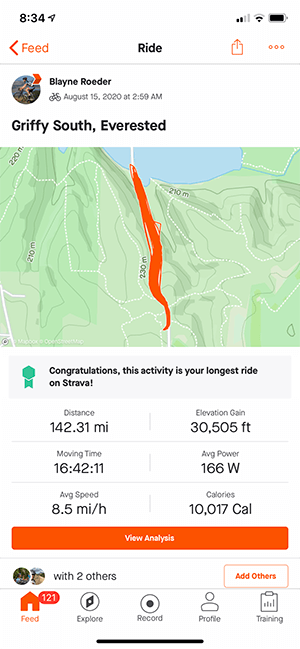
Well into their 17-hour bicycle ride up and down the hill on the south side of Bloomington’s Griffy Lake to benefit Habitat for Humanity of Monroe County, Blayne Roeder realized he and his fellow rider, Taylor Allen, had a problem. Going into the day, their plan was to “Everest” that hill—meaning they would do repeats until the total number of feet they climbed equaled the height of the world’s tallest mountain, Mount Everest, which tops out at 29,029 feet above sea level. Everything was right on schedule until they realized that their altimeters, devices which measure altitude change, were giving them different readings.
“His altimeter was measuring the hill a little shorter—and over 17 hours and 200 laps, a couple of feet every time up, adds up,” Blayne said.
They had a decision to make: end the ride at planned distance with only one altimeter reading the Everesting-qualifying 29,029 feet or ride an extra 10-15 laps so both altimeters would read a minimum of 29,029 feet.
How did they get there?
Blayne, director of New Ventures for Cook’s Global Research and Development team, started cycling around the time he finished graduate school at Purdue University in 2004. Up until then, he had been a runner, but transitioned to riding because he thought it was a better fit for his body type. An engineer, he was also intrigued by the strategy of the sport as well as the mechanical aspect involved with the bike.
“With running, you show up at a 5k, they fire the gun, and everyone is gone, and you are never going to see the guy who wins it again until you’re back shaking hands at the finish,” Blayne said. “In a cycle race, because of drafting and other things, you are likely to be in a competitive position a lot more often. It’s just a different type of competition.”
Over the next six years, he immersed himself in the sport, taking part in a variety of different types of races. But with family and career responsibilities taking up more of his time since 2010, he scaled back his competitive schedule to just the occasional time trial.
Then, near the end of last year, Blayne was contacted by some friends who were hoping to compete in the 2020 Leadville Trail 100 MTB, a 100-mile mountain bike race in Colorado. The entire Leadville course is more than 10,000 feet above sea level and includes over 10,000 feet of climbing. Riders have 12 hours to complete it. In an effort to minimize the ride’s impact on the remote trails on which it takes place, there is a cap on how many entrants can take part each year. Most of those riders are selected through a lottery.
“I said, ‘Sure, I’ll enter, knowing that with the lottery we probably wouldn’t get selected—but due to a whole strange series of events, we got in,” Blayne said. “So, I bought a mountain bike and tried to figure out a training plan.”
It was while figuring out how someone in Indiana could train for a 12-hour race in the mountains, that Blayne first came across the concept of “Everesting.”
“It’s something you could do that would be of at least comparable difficulty,” he said.
Everesting in Indiana, before heading to Leadville, became one of his training goals.
As has happened with so many things this year because of COVID-19, though, the decision was made to cancel this year’s Leadville Trail 100 MTB.
Rather than let the training he had already done go to waste, Blayne decided to make Everesting his end goal for the cycling year. Knowing how nonprofit organizations have suffered during the economic downturn brought about by the pandemic and having previously done some fundraising for Habitat for Humanity, Blayne decided to make the ride about more than just personal achievement.
“Habitat is a community building organization from a number of perspectives,” he explained. “It’s helping people in the community. It’s physically building our community. And at the same time, too, it’s not a handout. The homeowners are actively participating. They are putting in their sweat equity. I like that whole philosophy. It’s a whole culture and process that they put people through to help build them up into being a homeowner.
“So, I thought, maybe we can do this ridiculous bike ride in their benefit, to put a little bit of good into this terrible situation that we are all in.”
Putting in the work
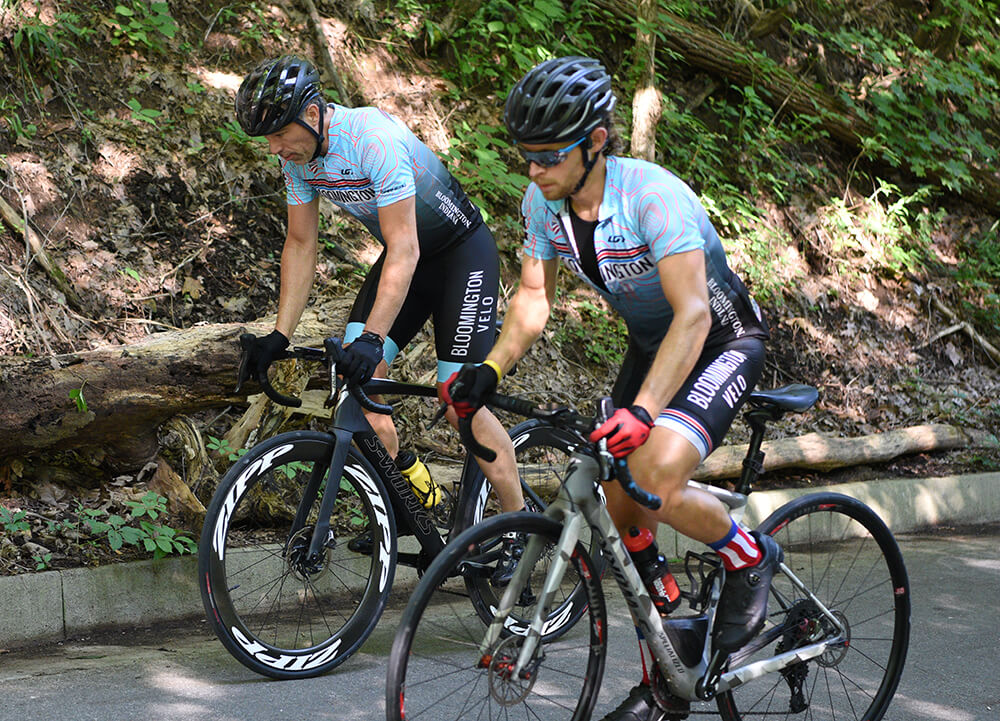
Fundraising and training became Blayne’s second and third jobs over the next three months.
The initial debate was whether he and his co-rider Taylor would base their fundraising on how tall Mount Everest is in meters (8,848) or feet (29,029).
“But in the US, almost nobody knows what a meter is,” Blayne said. “So, we decided to swing for the fences and put it in feet.” Thus, the goal became raising $29,029 for Habitat for Humanity.
To do this, Blayne began reaching out to friends, family, the local cycling community, and area businesses through meetings, email, and social media. For those who were unable to make financial contributions, he asked if they would be willing to share information about the ride to their followers on social media.
“Basically, I sent about 10 emails a night for about two weeks,” Blayne said. “That’s really what got it all started. Suddenly it skyrocketed and we were at $15,000-$20,000 in the manner of a couple of weeks. It was shocking. That part really took off, so I continued to follow up on that.”
You could argue that the steepest curve he had to ascend during this period wasn’t one of the many inclines in the surrounding area, but rather, getting a handle on internet platforms like Facebook and Instagram.
“I had been an avoider of social media up to that point in my life,” Blayne said. “I started to post some on Facebook and Instagram to spread the word about the ride. My daughter mocks me, though, she thinks I am terrible at it.”
In addition to the fundraising and his day job, Blayne was spending a minimum of 15-20 hours a week on his bike, trying to figure out how he was going to complete almost an entire day of climbing and descending.
It was a process that thrilled his engineer instincts.
Beginning in May, he started testing hills to see which ones had the right mix of length, altitude gain, a reasonable amount of traffic, some shade, and climb-ability so that he could maintain the necessary pace to complete the ride in 12-18 hours.
Among those he tested out was one many local cyclists consider a legend—the hill on Boultinghouse Road, northeast of Bloomington. It climbs 191 feet in less than a quarter of a mile with inclines of up to 25% and an average incline of 14%.
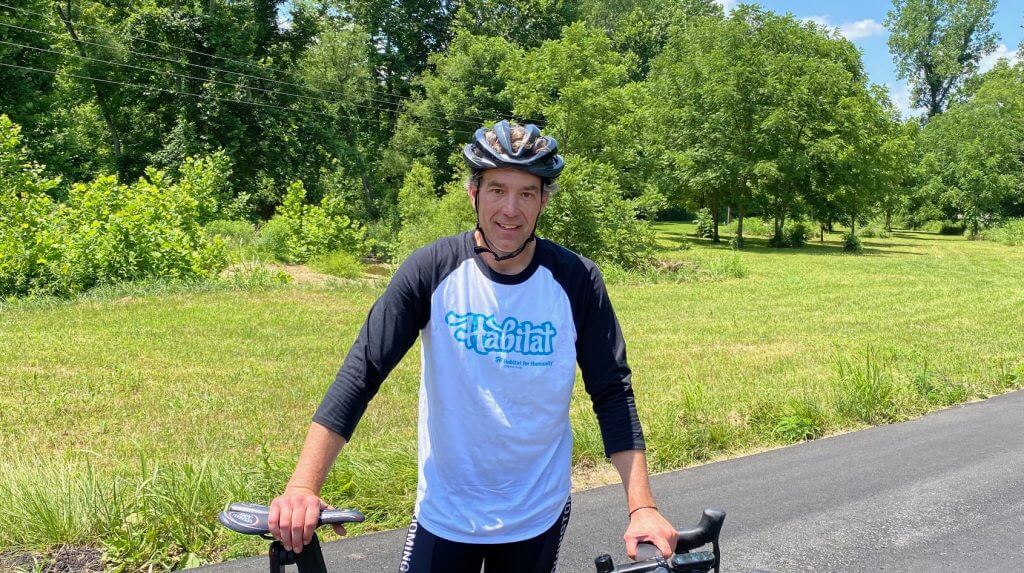
“It’s a wall,” Blayne said.
Still, he decided to do a “half-Everest” on Boultinghouse as part of his training. It didn’t go as well as Blayne had hoped it would.
“I was not able to get anywhere near the power numbers I needed to with the hill being so steep. My power numbers and effort required to get up the hill were significantly higher what I had planned for, and I was totally wiped at the end of it,” he said. “There are some pictures that my son took of me afterward. I had this god-awful look on my face, like somebody had beaten me.”
That effort did yield some positive results, though.
For starters, after 84 trips up Boultinghouse over the course of about eight hours (which included having to replace his brake pads, which had been worn out on the descents), no other hill in Bloomington seemed quite so challenging to Blayne anymore. Second, as word of what he had done became known to the local cycling community, it drew even more attention to Blayne’s full-Everesting attempt and, ultimately, the fundraiser for Habitat.
He went on to complete two more half-Everests during his training, including one on the hill he and Taylor selected to be “the one”—the hill that climbs from Griffy Lake south toward Indiana University.
Another highlight of his training was logging his longest ride ever, 13 hours, while doing a full Everest, climbing 30,000 feet on a virtual cycling platform, in his basement on an indoor trainer. He was able to maintain the effort he hoped to hold on Griffy hill, which was a confidence boost. But he was realistic about how that ride would translate to success for an outdoor attempt.
“There are some things that make the inside piece a little bit easier in that you can control your environment and you don’t have the stress of descending,” Blayne said. “That is something you have to worry about, because you are going to get really tired descending over and over and over and making sure that you are keeping safe.”
Almost as impressive as that ride itself, was how he kept himself fueled up and hydrated:
• 192 ounces of electrolyte mix
• 128 ounces of water
• Two double espressos
• Seven ham sandwiches
• Seven packages of energy chews
• One banana
• Nearly a jar of pickle juice
“It’s over 20 pounds of liquid alone, but at the end of the day, I still lost three pounds,” Blayne said.
In total, despite already leading an active lifestyle, he lost 25 pounds since he started training for Leadville just after Christmas.
So, with the hill selected and the training done, they selected a date to Everest outdoors—Saturday, August 15.
Reaching the summit
Starting the week before the ride, Blayne began reworking his sleep schedule, going to bed by 8:00-8:30pm and waking up at 4:00am in anticipation of getting an early start on the 15th. On that Friday, he was down by 7:30 pm, but struggled to control his racing mind—mentally reviewing his checklist to make sure he hadn’t forgotten anything he was going to need the following day. Eventually he was able to get some deep REM sleep, during which he dreamed that he was five hours late to the start. Instead, he woke up, as planned, at 2:00 am. He had his coffee and breakfast, took a shower, put on his cycling clothes and was in his already packed car and headed to Griffy Lake by 2:30.
At 2:59:55 am, five seconds ahead of schedule and under the cover of darkness, Blayne and Taylor headed up the hill for the first of their planned 230 or so trips to the top.
Not surprisingly, considering the amount of preparation and planning Blayne had done, the day, for the most part, was pretty uneventful.
The weather was unseasonably cool for August, especially during the first three hours before the sun came up. Traffic was practically nonexistent for almost that long.
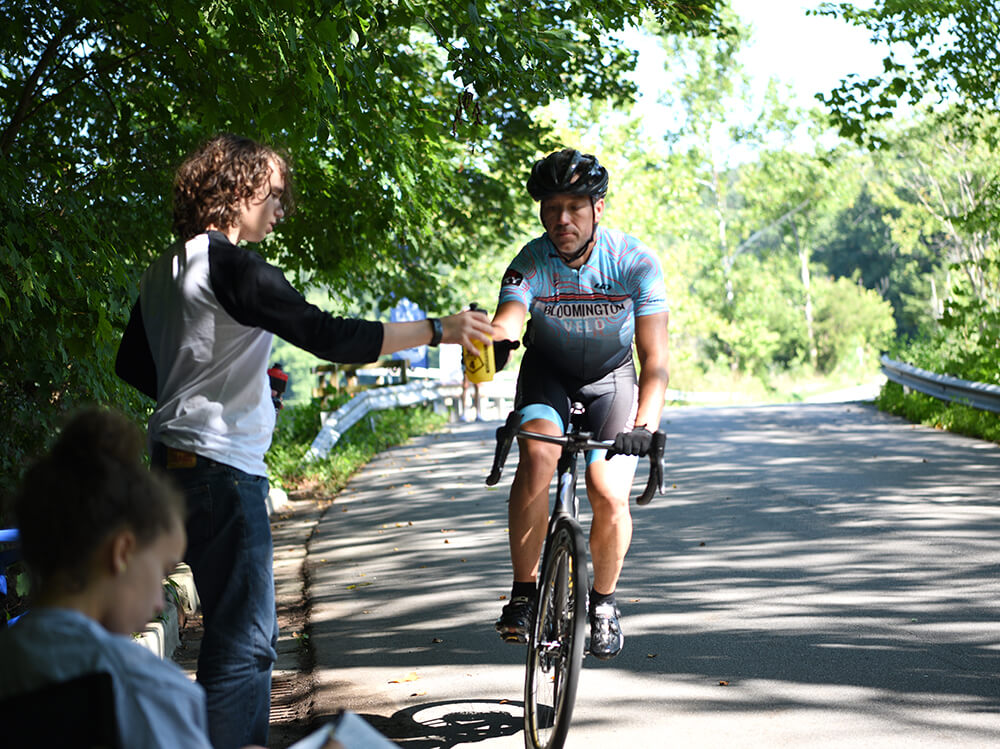
Even the rough patches they experienced during the event were not unexpected.
“Something that I had learned on previous training rides, you get to a point when you notice that your eyes are just a little tired,” Blayne said. “Physically you can still maintain the level of exertion you had planned. But having people around really helps with that. At one point during the day, a group of five or six who had been riding with us asked us if we wanted them to keep talking or to be quiet. We were like, ‘We don’t care what you talk about, make noise, anything.’ It made it so much better to have so many people around.”
Blayne and Taylor broke the ride up by taking a short rest every two hours. This allowed them to get off the bike, stretch, make adjustments, use the bathroom, and take in some calories. As the day wore on and the temperature rose, Blayne started taking an extra bottle of fluids—three in total—for the stretches between breaks. For the day (not counting the champagne and beer consumed after finishing), he ingested around 30 pounds of fluids.
In some ways, the climb up the hill was the easiest part of the ride. The downhills, on the other hand, held the potential for disaster. For starters, they would be reaching speeds in excess of 40 mph on the descent—a task that would require exponentially more focus as the day wore on and their fatigue increased. The other challenge was that Blayne had “trimmed all the fat” off of the route they were riding to ensure that they were only riding inclines.
“After doing a training ride on Griffy, I figured out that I could probably save myself 15-20 seconds a lap by optimizing the turns,” he explained. “So, I went out there the weekend before the ride and marked out five different turn points at the top and five different turn points at the bottom and optimized the turn points to minimize distance and maximize elevation. That turn was placed right at the bottom of the hill, so we didn’t ride any extra.”
The turn was a tight one that had them immediately climbing back up the hill. Still, after completing well over 200 laps the only near miss they had was when a cyclist coming down the hill almost collided with Taylor as he was making the turn.
In the end, the only decision-making they really had to do once they started riding, was how they were going to address the discrepancy in the readings they were getting from their altimeters.
“Everesting is really scored off of what your bicycle altimeter says, how many feet you gained,” Blayne said.
When they realized how different their altimeter readings were, their options were to just pick one altimeter and base their ride on that one—or keep riding until both of their altimeters recorded over 29,029 feet of climbing. Ultimately, they decided upon the latter—which ended up creating some confusion for the spectators. Blayne had gone into the day expecting to do a little over 230 laps—his altimeter ended passing their goal around lap 231 or 232. But to make sure that both altimeters reached those numbers they ended up doing 244 laps. As they continued climbing and descending they tried to explain to their support team what was going on as they passed by. The confusion came to a head when, after completing their 244th climb, they didn’t just pull into the parking lot at the top of the hill where their friends and family were waiting. According to the rules of Everesting, riders must end at the base of the climb—the same as those who ascend Mount Everest on foot.
“Everybody was kind of excited and thought we were done and then we turned around and went back down—and you could hear my wife Becky, who also works for Cook, say, ‘Where are you going?’” Blayne said.
Their job done, Blayne and Taylor headed back up one last time—to celebrate.
Conclusion
Other than a little leg stiffness the next day, Blayne was no worse for the wear after spending 16 hours 42 minutes on the bike. But when he looked back at the day, his first thoughts weren’t of riding.
“Everyone coming out to make it a really cool event—that completely changed my perspective,” Blayne said. “I was worried going into it that a lot of people around would make doing what we needed to do on the bike more difficult from a distraction standpoint. I couldn’t have been more wrong. Everybody there is what made the day. That was awesome. I can’t explain to people how much their encouragement helped throughout the day. That was really cool.”
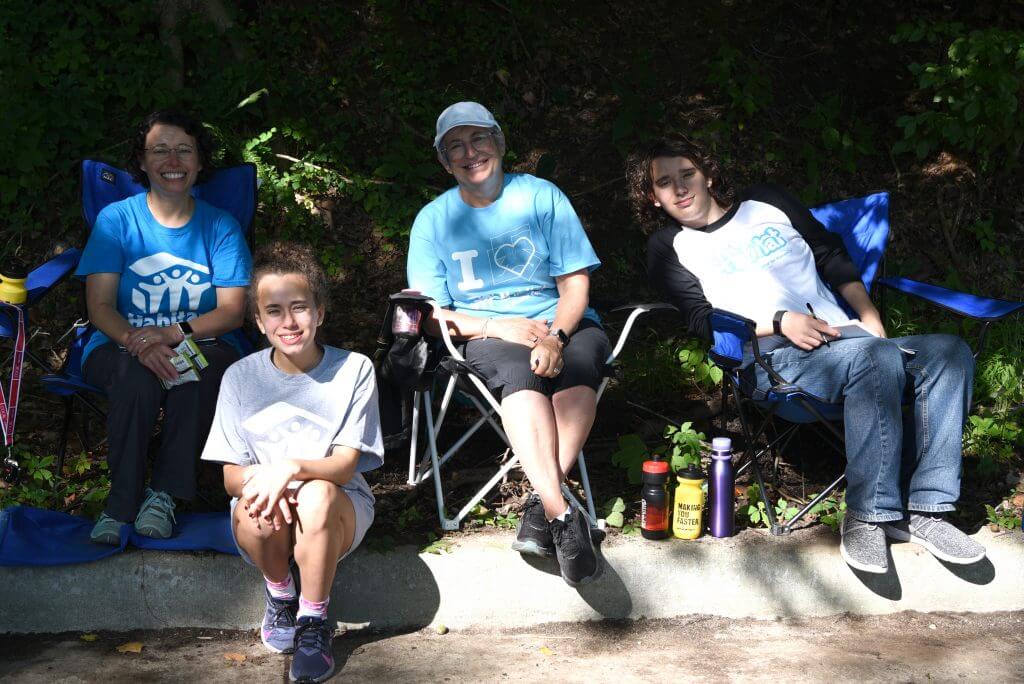
Even cooler, was that the only spectator who was there for the entire thing, was Blayne’s son, who served as the day’s official lap counter.
“He had a piece of paper with 233 boxes on it—and then had to hand-draw another 11 boxes to get us to 244,” Blayne said. “I have the paper at home—all the boxes have check marks in them.”
The most important outcome from the ride, though, was that they raised over $29,029 for Habitat for Humanity of Monroe County. While they met their goal, this isn’t the end of Blayne’s pursuit of Everesting or fundraising for Habitat for Humanity.
“I am amazed at how much the community got behind it and how much we were able to do for Habitat,” Blayne said. “Seeing what people were willing to do to support a worthy cause in the community—that will stick with me forever. That was just incredible.”
“I would say it has probably been one of the more rewarding things, if not the most rewarding thing, I have ever done,” he continued. “It has just been a lot of fun, honestly. And it’s been a great distraction with everything else that is going on in the world.”
“But to be honest, it’s a little bit like anything—sometimes it’s probably good when you don’t know what you’re getting into when you start,” he said with a laugh.
Want to read more stories like this?
Click the images below to check out other Life@Cook blog posts.

Uau! Congratulations to you! Well done! An inspiration story,really! Thank you!
Thanks Mirela. It has been fun to be part of. The response from the community has been the best part.
Wow, what an inspiring story! Well done Blayne on this great achievement.
Thanks Julia. We had a lot of fun with it all.
That is impressive! Congratulations, what a huge achievement on so many levels!
Thanks Lisa. Hope you are doing well.
Congratulations.. I ride myself. I love your commitment.
Thanks. If you are in Bloomington, come do a lap with us on Sunday.
Great stuff Blayne! Congrats to you and Taylor. I raised funds for the children of Myanmar way back in 2014 via Wheels of Hope charity ride but not many climbs. Mainly flat and undulating hills which was challenging enough given the hot and humid conditions in Malaysia.
Keep up the great work!
Thanks Samuel. A flatter ride sounds like a lot of fun right now!
Congratulations Blayne, amazing achievement!! What a great cause to support.
Thanks Shona. It is fun to support a cause that is literally building our community here in Bloomington.
Positively incredible, Blayne! Congratulations!
Thanks Dexter. It has been a fun journey (or bike ride) to say the least!
Congratulations. Inspiring and motivational.
Thanks Werner. I hope you and your family are keeping well in Australia!
Congratulations Blayne! Very impressive!!
Thanks Glenn. I has been fun to see the idea of Everesting for Leadville training grow to multiple Everestings with now 5-6 different riders/fundraisers to benefit Habitat
You are amazing, Blayne! Such a good work to contribute to. Congratulations!
Thanks Melissa. It is a fun way to help Habitat.
Wow. Amazing. Super human!
Thanks Roxanne. It was a fun any challenge. Equally challenging were planning the bike ride and fundraising!
Congratulations, Blayne!
Thanks Rae. Hope you are well
Congrats, Blayne! Way to give back to your community while accomplishing a monumental challenge!
Thanks Nick.
Boltinghouse? Ugh. I’ve ridden up it a few times, but more often have had to walk it.
Good job, Blayne!
We’re Everesting Boltinghouse this Sunday! We’re keeping Everesting for Habitat going!
This was an absolutely amazing achievement and the fact that Blayne was able to use the feat to better the lives of others makes it that much more impressive. I am so proud to be part of an organization with such dedicated and accomplished individuals.
Thanks Chris. It was so much fun we’re going to do it again. This time Sunday on Boltinghouse.
A monumental achievement for a great cause! CONGRATULATIONS!
Thanks Dave. It was a big bicycle ride, but the impact on Habitat is most satisfying.
Incredible!
Thanks Bob, a truly rewarding experience. The response from the community has been amazing.
Wow! Congrats Blayne, great achievement and resilience for a great cause. I owe you some money! I have to ask though, why on earth were you drinking pickle juice?!!
Electrolyte replenishment, Nicky. With sustained exertion (and sweating), the amount of sodium and potassium lost is impressive.
Pickle juice stops any leg cramps!! The science behind it is a little debated. Electrolytes help, but there are also some theories on the effect of the vinegar in interrupting neural pathways. I think there may be some merit to the later. You still get a little twinge in the muscle as normal, but it doesn’t evolve into a full leg cramp. I’ll resend you the donation website. It is still open. We have another Everesting planned!
Epic accomplishment and benefiting a great organization as well! Congrats, my friend.
Thanks Scott. It was great to see you on that bad day on Boltinghouse. I look forward to seeing you there on Sunday!